

Cybersecurity
Why Study Cybersecurity?
Graduate | Technology | CAS
One master's degree. Two tracks. 100% online.
Nearly 60% of all U.S. companies have experienced a security breach and the demand for experts in the cybersecurity field continues to grow exponentially. The online University of Wisconsin Master of Science in Cybersecurity teaches skills that align with current market demands. The curriculum addresses cybersecurity fundamentals and offers two unique tracks of study: secure systems design or digital forensics and security management.
Request a free program guide here.
Program Details
Tracks of Study
Students in the cybersecurity program can pursue one of two tracks. Explore your options below.
- Digital Forensics and Security Management: Digital forensics and security management unite digital evidence investigation with the governance and leadership needed to manage enterprise risk. Students learn how to collect and analyze digital evidence, plan and implement cybersecurity programs, and align security operations with business objectives, regulations and incident response, building the capabilities to prevent, detect and decisively respond to threats across the organization.
- Secure Systems Design: Secure systems design ensures the confidentiality, integrity, and availability of modern digital environments. This track explores the foundations of cryptography, secure software engineering, and system architecture, highlighting how security principles shape resilient applications and enterprise‑scale infrastructures. Students gain insight into how cryptographic tools, secure programming practices and architectural safeguards work together to protect data and make sure the system meets the organization’s security requirements.
Curriculum
View curriculum and core courses for the cybersecurity program.
Tuition and Financial Aid
Tuition is $850 per credit for all cybersecurity classes, regardless of where you live. Tuition rates for other courses, such as the prerequisite courses, may be different. Textbooks are purchased separately and are not included in tuition. Students who take at least four credits each term may be eligible for financial assistance.
Admission Requirements
Admission to the Master of Science in Cybersecurity requires:
- Bachelor’s degree with, at minimum, a 3.0/4.0 undergraduate GPA from a regionally or nationally accredited university or college
- Prerequisite coursework in Introduction to Computer Science which must include programming content and prerequisite coursework in calculus or statistics
- Resume
- Up to 1,000 word statement of personal intent describing your decision to pursue the degree and what you believe you will bring to the cybersecurity field
Aptitude tests (GRE, GMAT, e.g.) are not required. If you do not currently meet admissions requirements, a campus adviser can discuss options for enrolling in the program. Request a consultation with an adviser by sending an email to learn@uwex.edu.
You may apply and begin the program with the start of any term. Complete a UW System application online, pay the processing fee and have official transcripts sent directly to UW-River Falls from the colleges and universities that you have previously attended. Application materials must be completed two weeks prior to the semester start to be considered for admission.
Cybersecurity
graduateadmissions@uwrf.edu // 715-425-3500
Your Degree:
Graduate
Area of Study:
Technology
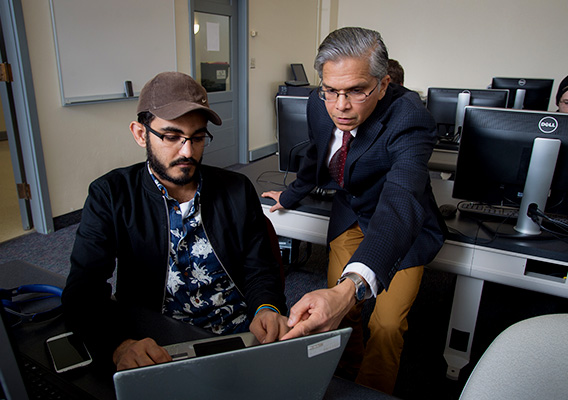
Skills and Learning Outcomes
- Analyze and resolve security issues in networks and computer systems to secure an IT infrastructure
- Design, develop, test, and evaluate secure software
- Develop policies and procedures to manage security risks
- Evaluate and communicate the human role in security
- Interpret and forensically investigate security incidents
Types of Courses
- Advanced Cryptography
- Cyber Crime
- Cybersecurity Ethics and Communication
- Digital Forensics
- Fundamentals of Cybersecurity
- IT Security Risk Management
- Network Security
- Security Architecture
- Security Program Management


Computer Science and Information Systems
- Degree Type: Major/Minor
- Area of Interest: Computer Science
- College: CAS


Data Science and Predictive Analytics
- Degree Type: Major
- Area of Interest: Data Science
- College: CAS