
UWRF scientist researches humane cattle stunning with grants from USDA, Dairy Innovation Hub
UW-River Falls scientist researches humane cattle stunning with grants from USDA, Dairy Innovation Hub
Oct. 6, 2026 – Karly Anderson, a scientist and trainer with the University of Wisconsin-River Falls Humane Handling Institute (HHI), is leading a new $300,000 research project funded by the U.S. Department of Agriculture (USDA) through its National Institute of Food and Agriculture (NIFA). The project is also supported by a faculty research fellowship through Wisconsin's Dairy Innovation Hub (DIH).
Working with co-investigator Kurt Vogel, director of HHI, Anderson will study the effectiveness of captive-bolt devices and recommended bolt placements used to stun cattle in meat processing plants. The research is intended to replace uncertainty with objective, science-based recommendations that can be used by slaughter establishments, livestock producers and others responsible for humane stunning or euthanasia of cattle.
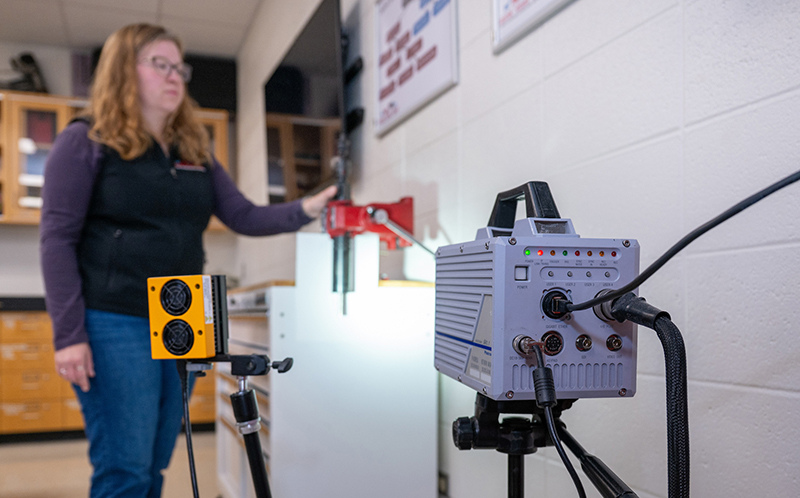
The project has two major components. One will use an ultra high-speed camera to precisely measure how far and how fast the bolts in commercially available captive-bolt devices travel. Though penetrative captive-bolt devices are the primary tool used to stun cattle in the United States, there is currently little independent information about exactly how far the bolts travel in the many different devices. The speed of the bolts makes the distance hard to measure.
“The fastest bolt speed that we’re aware of right now is about 207 feet per second,” Anderson said. “The ultra high-speed camera lets us slow down and figure out exactly what is the maximum bolt travel distance.”
The second part of the project will examine different recommended placement locations on the heads of several classes and breeds of cattle to determine whether they are likely to reach critical areas of the brain, particularly the thalamus, which Anderson describes as essentially an "on or off switch for consciousness." The project will use cadaver heads obtained from regional slaughter establishments for initial testing.
Anderson has done similar research with various beef cattle breeds. This project will examine five classes or breeds for which there is little or no relevant literature: fed Bos indicus cattle, fed Wagyu cattle, cull Jersey cows, cull Holstein breeding bulls and fed Holstein cattle.
“The research we’re doing will inform the guidance we give processors about the tools and placements that will be best suited for the animals they might get in their plants,” Anderson said.
With the additional funding from the Dairy Innovation Hub, Anderson will be assisted by Olivia Barber, a 2025 UWRF animal science graduate from Mosinee, who is working toward her master's degree in agricultural education with an animal welfare focus.
“I am very grateful to be able to join this team and conduct my own animal welfare research,” Barber said. “This research will help provide a more definitive and evidence-based placement location for a variety of cattle classes, which will overall help to improve animal welfare.”
Anderson has been conducting research of this kind at UWRF for around seven years. She earned her bachelor's degree in animal science from UWRF in 2019 and continued her master’s and doctoral research on campus while pursuing her graduate degrees through the University of Minnesota and University of Nebraska-Lincoln.
"I kind of never really left," Anderson said.
Anderson will make a presentation about the work at the Dairy Innovation Hub Dairy Summit Nov. 17 at the University of Wisconsin-Platteville. Once the work is completed, she expects to produce six peer-reviewed publications and the HHI team will share their findings through presentations at conferences and via their own training programs.
Photo 1: Karly Anderson, a scientist and trainer with the UW-River Falls Humane Handling Institute (HHI), activates a captive bolt device used to stun cattle while an ultra high-speed camera captures its movement. Anderson’s research, funded in part by a $300,000 grant from the USDA, will help inform humane stunning practices at meat processing operations. UWRF photo.
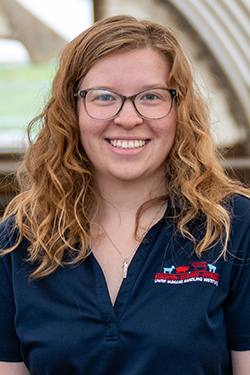
Photo 2: Karly Anderson. UWRF photo.