
UWRF professor discovers new orchid species in Palau
UW-River Falls professor discovers new orchid species in Palau
Rare orchid found only on one Pacific island highlights need for conservation
Sept. 29, 2026 — A University of Wisconsin-River Falls faculty member has discovered a previously unknown species of orchid found only on an island in the western Pacific. Assistant Professor of Biology Benjamin Crain is the lead author of research published in August in the journal, Harvard Papers in Botany, describing the species Agrostophyllum lkou. Crain found the rare orchid on Babeldaob Island in the Republic of Palau, located in the Caroline Islands north of New Guinea.
The discovery came through years of fieldwork, examination of historical botanical records and collaboration with orchid specialists.
For Crain, a conservation biologist and ecologist, the investigation began with an encounter in a tropical forest in 2018. He was measuring orchid diversity in the region while working for the Smithsonian Institution’s North American Orchid Conservation Center as part of the Palau Orchid Conservation Initiative.
While surveying the island, Crain spotted what looked like an orchid high in a tree. After pulling it down, he thought there was something unfamiliar about the plant, but it was mostly dead, which made it harder to identify.
“It jumped out at me as, ‘Hey, that doesn’t fit anything I’ve seen,’” Crain said. “It didn’t look like anything we had found in publications, but with a bunch of dead flowers, we had no evidence. There wasn’t much we could do.”
Crain began investigating the mystery orchid, searching scientific literature and historical records. He found an old botanical illustration that appeared to depict the same plant, but it seemed to be misidentified as another species.
Five years passed before Crain encountered the orchid again.
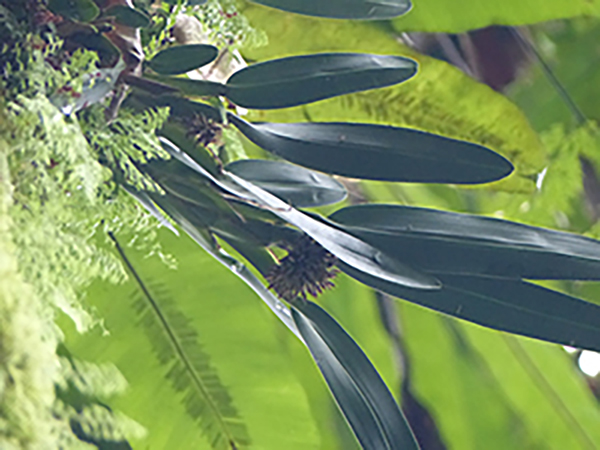
Back in Palau in January 2023, Crain found plants with fresh flowers, fruit and seeds, giving him the material he needed to take a much closer look. When he dissected the flower, some of the structures appeared to be upside down or backwards. A cone-shaped structure also made it unlike other known members of the genus Agrostophyllum.
Crain shared a sample with a friend at the Royal Botanic Gardens, Kew in London, who is an expert in the orchids of New Guinea. He agreed the specimen did not match any known species in the region.
The researchers continued their detective work, comparing the orchid with historical specimens and herbarium collections and digging through descriptions of known species in old literature, some of which offered conflicting conclusions. After much effort, Crain’s initial hunch was determined to be correct.
“It is definitely a new species,” Crain said.
Crain and his collaborators named the new orchid Agrostophyllum lkou. “Lkou” is a Palauan word for “hat,” a reference to the cone-shaped structure on its flower that reminded him of a witch or wizard’s hat.
“The idea was to keep Palauan culture in mind and get a little creative with it,” Crain said.
Fewer than 50 mature A. lkou have been documented so far, making it a critically endangered species. Crain said identifying and describing the species is the first step in determining how to best protect it.
“I just want these things alive and well,” Crain said. “If it’s sick, if it’s declining, I want to do my part to make sure that gets reversed.”
Crain’s work in Palau also examines the relationship between orchids and the fungi they depend on to germinate and begin growing. By collecting the orchid’s seeds and their associated fungi, scientists may be able to reintroduce the rare plants into suitable habitats.
While many of the researchers Crain works with have identified new plant species before, he says that is not typically the focus of his work, so identifying and documenting something new was a unique opportunity for him.
“I wasn’t out there to find new species,” Crain said. “I just happened to be in the right place at the right time with a good eye for what might be out there.”
Photo 1: An example of the orchid species Agrostophyllum lkou growing in Palau. Contributed photo.
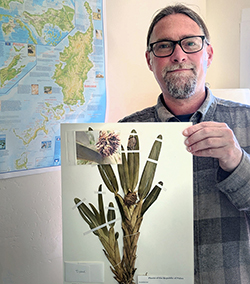
Photo 2: (inset) UW-River Falls Assistant Professor of Biology Benjamin Crain holds a sample of a new species of orchid he helped discover on a Pacific island in Palau. Crain's research, conducted for the Smithsonian Institution, was recently published in the journal, Harvard Papers in Botany. Contributed photo.