
Humane Handling Institute trains livestock processors in safe and humane handling
UWRF Humane Handling Institute trains livestock processors in safe and humane handling
Sept. 2, 2026 - “We built this program from the ground up for you," said Kurt Vogel, director of the Humane Handling Institute (HHI) at the University of Wisconsin-River Falls, as 17 meat industry employees from around the country gathered for a workshop in April. "We believe people learn best when they are having fun.”
Livestock handling training and fun may not sound to everyone like they go hand in hand, but what followed was two days of interactive, hands-on learning about safe and humane ways to handle livestock, leaving participants feeling better prepared to carry out the important work of providing food for the nation.
U.S. meat processing facilities must follow the Humane Methods of Slaughter Act, which requires that all animals must be rendered immediately insensible with a single stun, that animals are handled with minimal excitement and risk of injury and that there be no egregious acts of abuse. Processors must pass USDA inspection and an allegation of abuse can shut down operations.
Before HHI was founded in 2022, there were no training centers for humane handling and stunning in the United States.
"Our mission is to improve animal welfare, worker safety and trust in food animal agriculture through robust and meaningful education, outreach and research," said Vogel, who is a professor of animal welfare and behavior at UWRF and the founder of HHI.
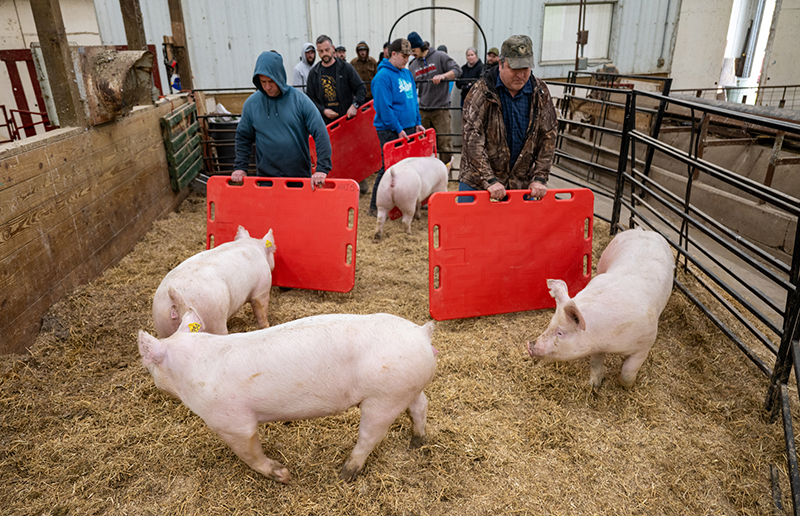
On day one, participants received instruction in the anatomy of a cow's head, learned about electrical and captive bolt stunners and practiced with model heads. Day two covered the principles of livestock handling and behavior. Attendees worked with live sheep, goats, pigs and cattle on the university's farm. They also experienced a recent addition to the program: cow vision goggles.
"There’s only one place in North America you can have this experience," said HHI Program Manager Ashlynn Kirk as she introduced the goggles to the group.
Kirk spearheaded the effort to bring the innovative technology to UWRF from a company in Germany in late 2025. Formally known as the Animal Eye Simulator, cow vision is a combination of augmented reality goggles and software that allows participants to see as a cow would see—wide peripheral vision with limited color, poor depth perception and slow adjustment to light.
"Whoa!" said Richard Flannery of Central Point, Ore., when he put the goggles on. "Just... whoa."
"It was trippy," Flannery said after navigating through a barn and cattle chute wearing the goggles. "It's really interesting seeing through the eyes of a cow. It was really disorienting from my normal point of view."
Participants saw how something as simple as a shiny tarp on the ground, sunlight shining through an open door or a yellow vest hanging on a railing could cause cattle to stop when moving through a facility.
Attendees and business owners say the workshops help employees build the skills and confidence they need to be comfortable with the work they do.
Clay Cooper, who works for a beef, pork and lamb processor in Ohio, said he is fairly new to the industry and learned a lot from the workshop.
"The instructors were really passionate about humane handling and passionate about the food industry—that was really obvious in their teaching," Cooper said. "My biggest takeaway would probably be the animals' point of view when they're handled through a processing facility and the low-stress handling of the animals."
Shawna Montgomery, co-owner of Mongomery's Meat Company with locations in California and Oregon, was attending her second workshop with staff from her family-owned company. Before attending her first workshop a year and a half earlier, Montgomery said she and her husband were struggling to open a USDA facility from scratch, navigating all the terminology, rules and regulations.
"I was about to give up when I came here because there was no template or instruction," Montgomery said.
After attending the class and getting help creating a humane handling plan, Montgomery left with the inspiration and confidence she needed to launch a successful operation.
"We have had zero incidents of any type of problem," Montgomery said. "I feel that attending these classes is what led us to that success."
HHI offers workshops for meat industry employees and dedicated sessions for UWRF students. The next professional Humane Handling and Stunning workshop is Sept. 17-18. Learn more at uwrf.edu/humane-handling-institute/learn-us.
Photo: Participants practice guiding pigs using sorting boards during a Humane Handling and Stunning workshop at the UW-River Falls Humane Handling Institute (HHI) in April. The next workshop for meat industry employees is scheduled for Sept. 17-18. UWRF photo.