
UWRF and nonprofit team up to bring speech and hearing help to children in Jamaica
Traveling with a purpose: UW-River Falls and nonprofit team up to bring speech and hearing help to children in Jamaica
July 14, 2026 — When Sarah Smits and Tonja Lesmeister first became acquainted in River Falls as parents of kids around the same age, it may have been hard to imagine that their chats would lead to bringing much needed hearing and speech services to children in need thousands of miles away.
“It literally started over a cup of coffee,” said Smits, who is director of the University of Wisconsin-River Falls Speech-Language and Hearing Clinics, graduate program director and co-chair of the Communication Sciences and Disorders Department.
Lesmeister, along with her husband, Troy, is the co-founder of Traveling with a Purpose (TAP), a secular nonprofit that organizes service trips for volunteers. The idea was born when the couple adopted two children from Jamaica and wanted to do more to help children there. TAP now organizes trips that take advantage of whatever skills and talents their volunteers bring. Lesmeister saw a perfect opportunity to put Smits and her students’ skills to work.
“I planted the idea with Sarah that there was a lack of speech and language support on the island, especially the north side,” Lesmeister said. “I said, ‘We've got some students who could really benefit from these services.’”
TAP supports three institutions in Jamaica: Robin’s Nest Children’s Home, Montego Bay Community Home for Girls (also referred to as Melody House) and the Montego Bay Autism Center, the only center of its kind in Jamaica.
Karri Colberg is a clinical supervisor in UWRF’s clinic and serves as vice president of TAP. Graduate students under her supervision first began providing services virtually via teletherapy and have now taken three trips to Jamaica since the collaboration began in 2019. They’ll take their fourth trip August 4-11, where they’ll have a chance to work directly with families and assess new clients. All the services are provided free of charge.
“We provide education to parents and teachers at the autism center,” Colberg said. “We've provided them with curriculum, software and educational materials. We've provided resources for speech and language development with the two children's homes.”
Colberg said beyond offering therapy sessions, they work to make sure the benefits of the program are long lasting.
“It’s very much parent-child focused teaching,” Colberg said. “Our role is to teach the parents how to be the therapists.”
Lesmeister said the results have been phenomenal. In one example, she met a 15-year-old girl and could only understand about 20% of her speech. Unable to communicate, the girl could not attend school.
“The grad students started working with her and the next time I went down, I could understand 80% of what she was saying,” Lesmeister said. “She was enrolled in a school down there and she ended up graduating. And not only did she improve academically, but I saw a huge change in her confidence.”
Lesmeister says it isn’t just the children who gain something from the exchange. Something happens for the volunteers as well.
“One of the things I love to see, and it usually happens around day number four, is my team members start recognizing that they’re not just there to give, but they’re getting something out of it as well,” Lesmeister said.
UWRF is one of just two programs in the nation where graduate students can count working with clients in another country toward their required clinical hours. Between the trips, the teletherapy care and the cultural training they receive, the students get professional experience that sets them apart.
“Every different experience you encounter during your training shapes the professional you become,” Smits said. "Every student in our program has an opportunity to work with and does work with at least one of these clients at some point.”
Taylor Feuerhelm traveled to Jamaica in 2023 as a graduate student in UWRF’s speech-language pathology program and worked with a Jamaican client via teletherapy. Now a full-time speech-language pathologist, Feuerhelm also serves as secretary of the TAP board and supports the group’s social media efforts.
“No words can fully capture what this experience meant to me,” Feuerhelm said. “The relationships I built, the lessons I learned and the experiences I shared have left a lasting impact that words alone cannot adequately describe. Each interaction offered valuable lessons and provided me with values that I continue to carry with me both personally and professionally.”
TAP is currently exploring expanding their trips to Guatemala. Lesmeister said they are always looking for more volunteers and they don’t need to have any specific set of skills. Volunteers have put medical, construction, accounting, website skills and more to very effective use.
Lesmeister said the group focuses on sustainability projects, meaning any project that continues to benefit people after the volunteers leave. She said the speech services provided by UWRF have lived up to that goal.
“There are parents who have not been able to communicate with their children and now they can communicate with them and understand their needs,” Lesmeister said. “It’s just been huge.”
To learn more about supporting or joining Traveling with a Purpose, visit travelingwithapurpose.org/take-action.
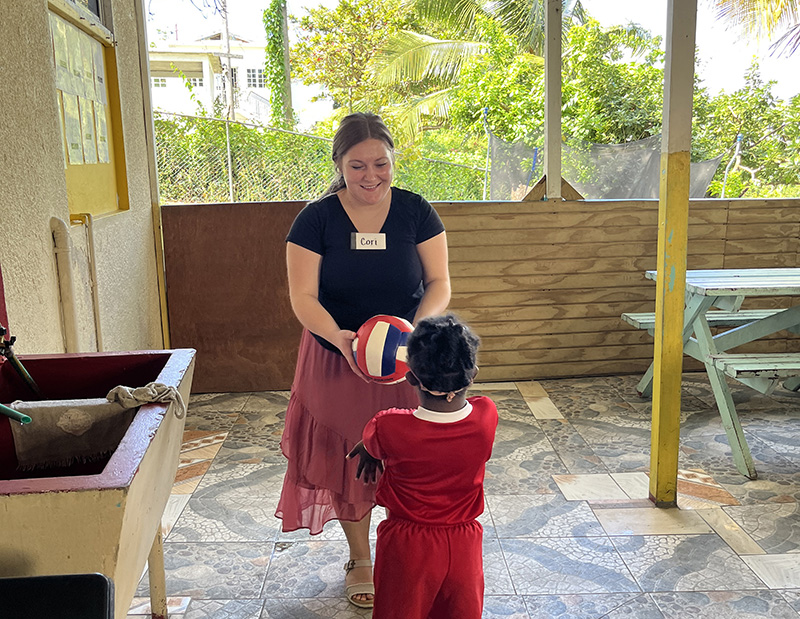
Photo: Cori Olson, a communication sciences and disorders graduate student at UW-River Falls, interacts with a child at the Montego Bay Autism Center during a service trip to Jamaica in January 2025. UWRF and the nonprofit Traveling with a Purpose will collaborate on their next trip in August. Contributed photo.