
Rockets’ red glare: Falcon Rocketeers win NASA WSGC Collegiate Rocket Launch Competition
Rockets’ red glare: UW-River Falls Falcon Rocketeers win NASA WSGC Collegiate Rocket Launch Competition
July 3, 2026 — The University of Wisconsin-River Falls Falcon Rocketeers were named Grand Champion of the 2026 NASA Wisconsin Space Grant Consortium Collegiate Rocket Launch Competition, held April 24-25 at Richard Bong State Recreational Area in Kansasville. The team received a $3000 prize and a VIP Tour of Sierra Space in North Freedom.
“I am very happy with the rocket team's performance,” said Team Lead Brook McLaird, a senior physics major from Kansas City, Kan. “We put in a lot of work throughout the school year and I am so pleased that it paid off!”
The team worked on the project from September through May, designing and building the rocket, reporting on their progress, participating in the launch competition and producing a final report after the launch.
“We have to write four reports and create two presentations,” McLaird said. “The judges use these reports to not only make sure we are planning and building a safe rocket but also assess our time management, project management and teamwork.”
The teams are judged on their reports and presentations as well as the performance of their rocket at the launch event. The rocket launch is judged on altitude, design challenge success and safety. This year’s design challenge was to stabilize the rocket in flight and have it rotate 90 degrees clockwise, hold for five seconds and rotate back 90 degrees counterclockwise, then deploy all parachutes and land without being damaged. This year’s rocket reached an altitude of 3,600 feet, the highest of all 10 teams in the competition and 1,000 feet higher than the Falcon Rocketeers’ third place finish in 2025.
The team’s faculty adviser, Physics Professor Suruj Seunarine, said the effort is entirely student led.
“I’m very proud of them and very impressed by their execution of the challenge, especially the complicated rocket roll that required high precision control,” Seunarine said. “They had a good balance among leadership, experience and skills, and there was no shortage of enthusiasm.”
McLaird said the team was thankful for the guidance of Seunarine and Physics Department Chair Glenn Spiczak, who has served as director of the Collegiate Rocket Launch Program for WSGC since 2024.
McLaird, who plans to go to graduate school for astrophysics, said the team drew on skills beyond physics to complete the challenge, and the experience was a valuable one.
“The most important skill, in my opinion, is time management,” McLaird said. “There are strict deadlines that must be met to do well. Along with that, we all get to practice our leadership, critical thinking and public speaking skills.”
McLaird said she knew nothing about rocketry when she joined the team to meet new people as a first year student. Now, as team lead, she wants it to be known that every team member contributed to their win.
“Everyone on the team does an amazing job and there are many who take charge and teach others,” McLaird said. “I am so proud and grateful for this team that I get to be a part of.”
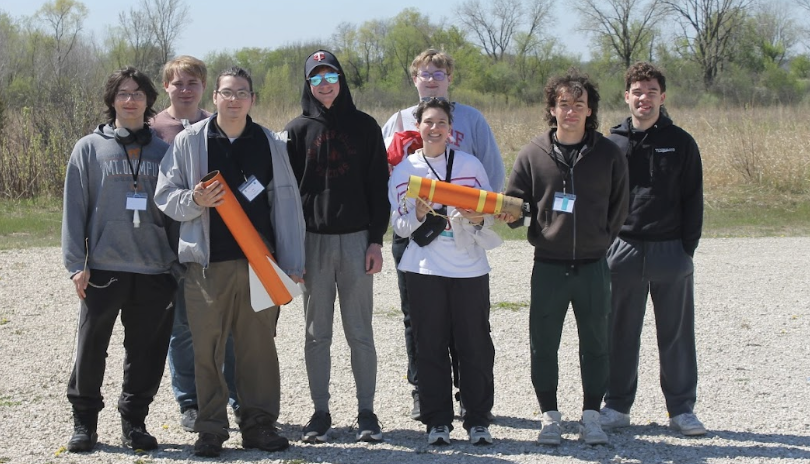
Photo: The UW-River Falls Falcon Rocketeers pose for a photo with their winning rocket at the 2026 NASA Wisconsin Space Grant Consortium Collegiate Rocket Launch Competition, held April 24-25 at Richard Bong State Recreational Area in Kansasville. Pictured L-R: Raidyn Bilotta, Sam Sackett, Jonathan Tabora, Peter Bendel, Evan Sander (back), Brook Mclaird (front), Mauricio Cuevas, Ian Vanveen. Contributed photo.