
Looking inside AI: UW-River Falls students apply math skills to AI challenges
Looking inside AI: UW-River Falls students apply math skills to AI challenges
June 23, 2026 - Generative artificial intelligence (AI) can be used to create new content in imitation of previous human-generated content. But what happens as more and more of that online content used to train AI models has already been generated by AI? That was the question posed in a recent mathematics modeling competition and three University of Wisconsin-River Falls students rose to the challenge.
The SIMIODE Challenge Using Differential Equations Modeling (SCUDEM) is presented by the Systemic Initiative for Modeling Investigations and Opportunities with Differential Equations (SIMIODE), a U.S.-based non-profit educational organization. Participants in SCUDEM get a real-world challenge that can be solved using differential equations, which describe how things change over time.
UWRF Mathematics Professor Kathy Tomlinson felt the challenge would be a valuable experience for students to not just to apply their math chops but to sharpen other marketable skills.
"Students who take part in a competition like this grow their experience in teamwork, communication, math and technology,” Tomlinson said. “Those are real-world job skills that can help them in interviews.”
Tomlinson recruited three mathematics majors for the challenge. Corbin Wild, a first year student from River Falls, was the youngest member of the team but had gotten a head start on his college career by taking mathematics and statistics classes at UWRF through dual enrollment programs while in high school.
“We chose the AI model decay challenge because it is a huge topic today and what we were most interested in,” Wild said. “We had to model how AI data quality can decrease as time goes on when it utilizes other AI-produced data on its own or mixed with real human data. This would help show the impact of AI hallucinations and how, without constant development, the quality can drop significantly.”
Wild said while his teammates, both seniors, handled most of the heavy computational work, he helped come up with ideas for models and helped put the presentation together.
“It gave me experience working in a group as well as communicating and presenting,” Wild said. “These skills are just as essential as the mathematics work itself, being able to explain your findings to a broader audience. It gave me a window into the applicative process of mathematics too.”
Andrew Sandberg of Hudson and Marcos Martinez of Hastings, Minn., were both in their final semester at UWRF during the project, which was carried out over five weeks starting in mid-October. Sandberg said the team began by reviewing published research papers covering AI model collapse and the growing amount of online content that is generated by AI. They then came up with ideas about how they could model the situation and sought out data to which they could fit their models.
“We all played a large part in the information-gathering phase as well as the presentation phase,” Sandberg said. “My focus was on the fit—using programming and statistics to take our theoretical differential equations and apply them to the real-world data—and on visualizing data distributions to show how AI can pollute or alter data pools.”
Tomlinson and all three team members learned to use the MATLAB computing platform to complete the work.
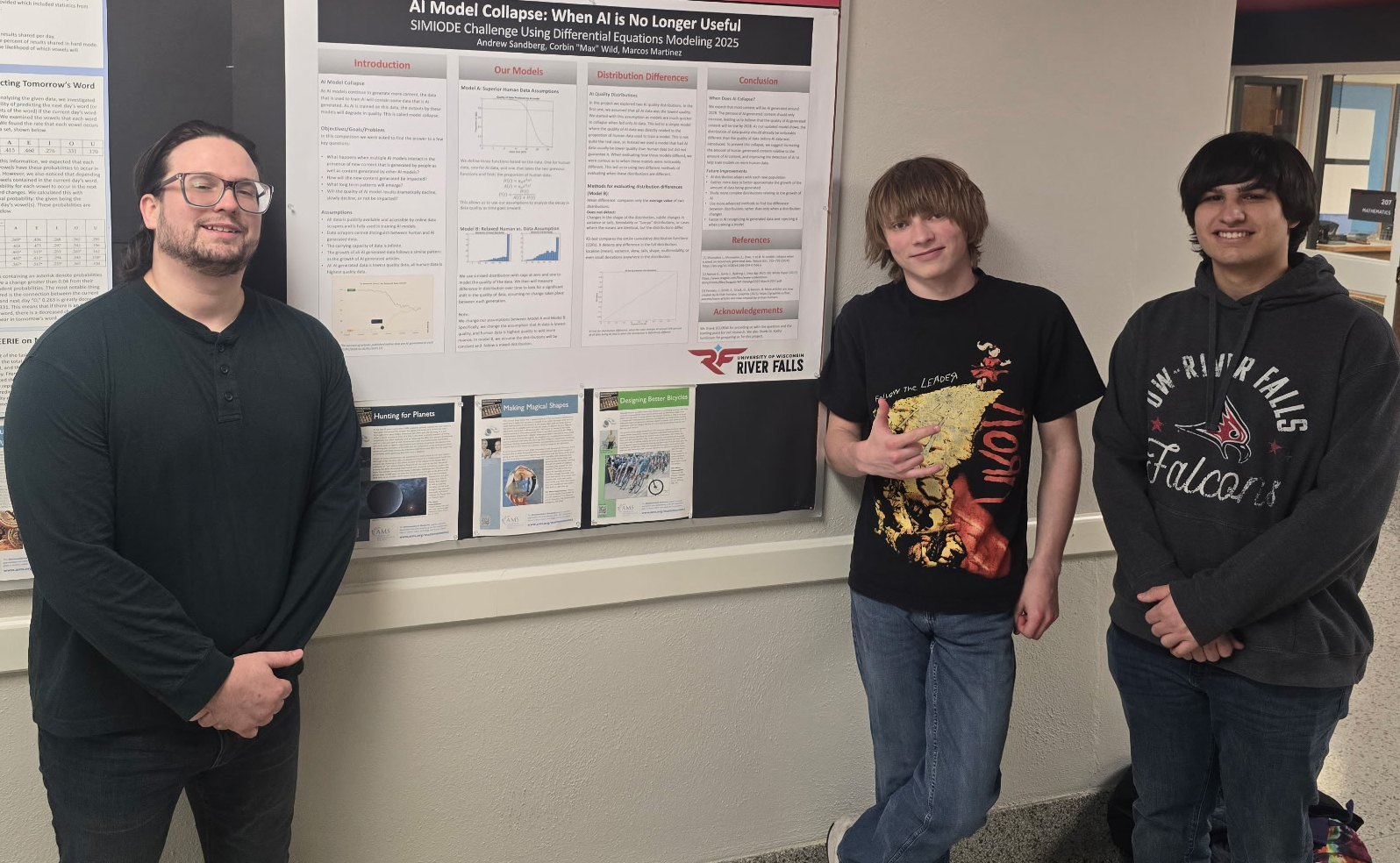
The team concluded that most online content will be AI generated by 2028, which will result in increasingly low-quality content. To prevent this, the team recommended increasing the amount of human-generated content and improving the detection of AI-generated content so that models can be trained primarily on human-generated data.
The competition issues three levels of awards: Outstanding, Meritorious and Successful Participant. The UWRF team received a meritorious designation. Tomlinson was excited about the result.
“They did great work,” Tomlinson said. “They learned and applied a statistical method that is not covered in UWRF math coursework, called the Kolmogorov-Smirnov (KS) test, and their presentation was very polished. I am very proud of them. And I am happy to see them get a high rating.”
Martinez, who has accepted a position as an actuarial analyst with Deloitte in Minneapolis, said that while entering a mathematics competition may not sound like everyone’s idea of fun, working on the project and presenting the research at the UWRF Undergraduate Research, Scholarly and Creative Activity (URSCA) Fall Gala, gave him the confidence and the evidence to go out and land a job in his field.
“Many employers love hearing that you have worked with AI. It definitely makes a prospective employer’s ears perk up,” Martinez said. "I think presenting at Fall Gala and having this loaded as an example to talk about during interviews helped me gain confidence when talking about projects I have worked on. It is important to be able to sell yourself to others and this competition sold me on myself and the work that I can do.”
Photo: UW-River Falls mathematics majors Andrew Sandberg, Corbin Wild and Marcos Martinez stand with the poster they created to describe their research into the quality of AI-generated content. The team won a Meritorious designation at the SCUDEM mathematics competition in December 2025.