
Dual enrollment programs give high school students a head start on college degrees
Dual enrollment programs give high school students a head start on college degrees
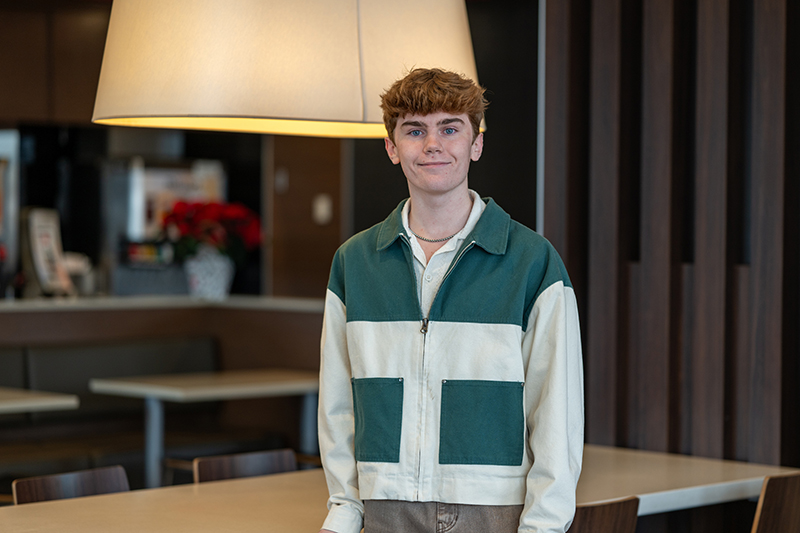
March 24, 2026 - Hayden Halstead, a first year University of Wisconsin-River Falls management major from New Richmond, had a great start on a college degree and a career before he even graduated from high school. Halstead already had work experience as a manager at McDonald’s, where he started working at age 14, and he started earning college credit as a junior by taking chemistry classes from UWRF through the Dual Academic Credit Program (DACP).
“I have always tried to challenge myself, try new things,” Halstead said. “I saw that opportunity and thought, ‘Hey, I'm interested in chemistry. I’ll try that.’”
Halstead already had the business program at UWRF in mind, but taking dual credit classes and visiting the campus helped confirm that decision. Having completed college level classes while still in high school made him feel ready to take on college coursework.
“I think it was good preparation,” Halstead said. “It kind of got me in that mindset, seeing what college courses were like.”
Halstead continues to work 30 hours a week as a manager while carrying 16 credits at UWRF. He looks forward to using his leadership skills in his future career.
“I'm really passionate and I like to take a group of people and build them into a team.”
DACP is a dual enrollment program that allows students to earn high school and college credit simultaneously by taking a class at their high school taught by a high school teacher who has met certain qualifications to be approved as a university instructor in their areas of expertise. The teachers work with a university professor mentor.
In another dual enrollment program, the Early College Credit Program (ECCP), students also earn simultaneous high school and college credit, but they take the classes on a Universities of Wisconsin campus or virtually, taught by a university professor.
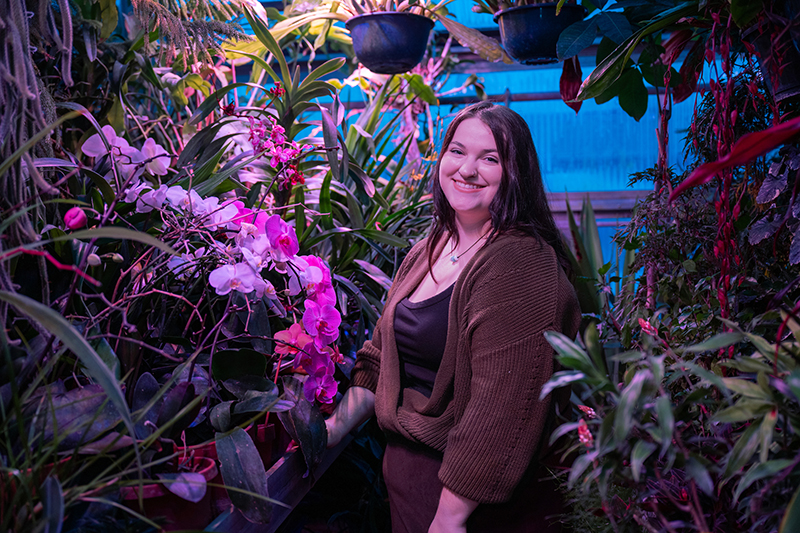
Annabelle Jensen, a senior from River Falls double majoring in horticulture and Spanish, began her college journey early by taking Spanish, plant science and soil science courses while still in high school via the ECCP at UWRF.
The classes put Jensen on course to be the first in her family to attend college and gave her a great head start on her double major. It was a visit to the UWRF campus, however, that really set her on the path to her future career.
“I fell in love with the greenhouse,” Jensen said. “With the lights, it glows at night. I was like a moth to a flame.”
Jensen developed an interest in hydroponic commercial production while conducting experiments growing potatoes in water.
“Not every place has the perfect soil for growing food,” she said. “In water, you can grow practically everything. That made me optimistic about what we can do in the future, feeding whole communities.”
A study abroad opportunity in Puerto Rico allowed Jensen to experience food production in a tropical climate and to further develop her Spanish skills. After graduation, she would like to work in a laboratory setting, possibly in a Spanish-speaking country or a community where the language is used.
“With two majors, I have done double the work, so I'll have double the opportunity,” Jensen said.
Jump starting a degree
Jensen’s case is a good example of how dual enrollment can help students get a head start on a college degree, said Jamie Schneider, assistant dean of the College of Arts and Sciences who serves as the administrator of dual enrollment programming at UWRF.
“Having those credits gives students more flexibility to take a semester abroad, pursue deeper credentialing, work and participate in sports and extracurriculars without delaying graduation,” Schneider said.
Students who earn college credit while in high school are more likely to continue their education and earn a degree. Over 87% of Wisconsin students who earn dual enrollment credits from UWRF go on to attend a college or technical college after high school. 45% attend a Universities of Wisconsin campus.
“They have built their confidence and know they can be successful,” Schneider said. “By the time they get to campus, they have already learned a lot about ‘how to college.’”
Another benefit is the opportunity for students to take classes not offered by their high school, including introductory career courses in fields like social work, teacher education and engineering. Dual enrollment students also have access to UWRF library systems, involvement activities and events including athletics, theatre and music.
Students who earn dual enrollment credits from UWRF are also guaranteed automatic admission and a $1,000 scholarship if they choose to enroll at the university after high school.
Corbin Wild, a first year mathematics major from River Falls, took statistics and calculus classes from UWRF through both DACP and ECCP.
The classes helped Wild realize he had a strong interest in statistics.
“Statistics plays such a huge role in our everyday life,” Wild said. “We see it all over the news, you see it in reports and it’s about interpreting and understanding that information.”
Wild plans to put his statistical skills to work as an actuary. Actuaries use data analysis to assess risk and drive strategic decisions, often working in the insurance or financial and retirement industries.
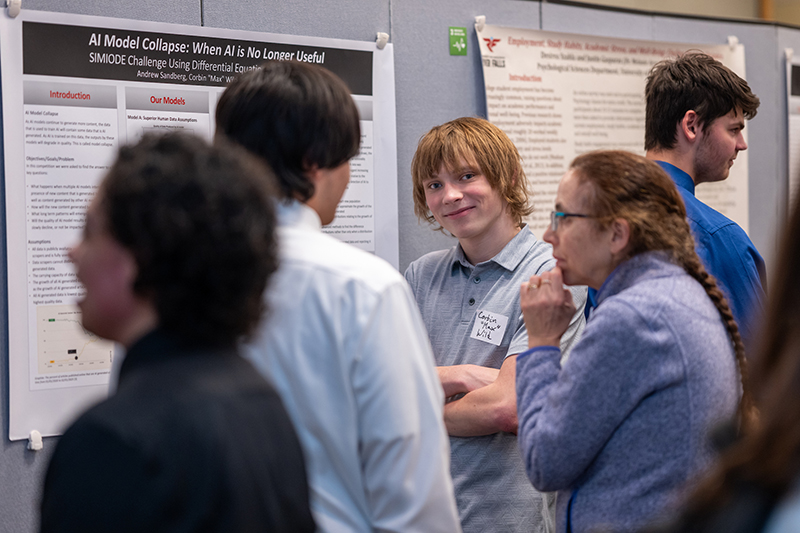
Wild was able to work on a research project in his first semester as a degree-seeking student at UWRF because of the advanced math coursework that he completed through DACP and ECCP.
“What an amazing opportunity to be able to showcase such great thinking and communication skills as a first year student,” Schneider said.
Besides keeping up with his classwork, Wild participates in the UWRF Honors Program and Actuarial Club and works part time as a teller at River Falls State Bank.
Growing enrollment
More than a quarter of Wisconsin high school students now earn dual-enrollment credits from a university or a technical college and the number of students participating continues to grow. During the 2019-2020 school year, 126 students from 14 participating high schools earned 704 total credits through UWRF dual enrollment programs. In 2025-2026, the number has grown to serve 675 students earning 3157 credits during the fall semester alone with another 405 students earning 1763 credits in the spring semester. The students in 2025-2026 came from 46 different Wisconsin high schools along with home-schooled pupils.
DACP at UWRF currently partners with 32 teachers from 13 different Wisconsin high schools with more approaching the university yearly. Current participating schools include Amery, Arcadia, Belleville, Glenwood City, Holmen, Hudson, Marshfield, New Richmond, Osceola, River Falls, Somerset, Spring Valley and St Croix Central. DACP classes come from a variety of disciplines including agriculture education, biology, chemistry, English, engineering, environmental science, mathematics and statistics, music, physics, political science, psychology and teacher education.
Students in ECCP take predominantly 100- and 200-level classes from across the full range of course offerings at UWRF as they explore interests in different majors and general education programming. Participation in ECCP is more individualized by student requests with students from over 70 different Wisconsin high schools completing coursework through ECCP in the past five years.
“We are proud to bring these advanced coursework options to so many students from across the state of Wisconsin, including many rural partner high schools,” Schneider said.
For more information about earning college credit from UWRF while in high school, visit uwrf.edu/admissions/high-school-credit-options.
Photo 1: UW-River Falls management major Hayden Halstead is pictured in the McDonald’s where he works as a manager. Halstead got an early start on his college degree by taking UWRF chemistry courses while still in high school. UWRF photo.
Photo 2: Annabelle Jensen, a senior double majoring in horticulture and Spanish, stands in the UW-River Falls greenhouse. Jensen says taking college courses while still in high school gave her a head start on her degree and helped her find her career path. UWRF photo.
Photo 3: UW-River Falls mathematics major Corbin Wild presents a research project at the 2025 Undergraduate Research, Scholarly and Creative Activity (URSCA) Fall Gala. Taking dual enrollment college courses while still in high school helped Wild prepare for college and discover his interest in statistics. UWRF photo.