
Criminology students put research skills to work to fight sexual exploitation
Criminology students put research skills to work to fight sexual exploitation
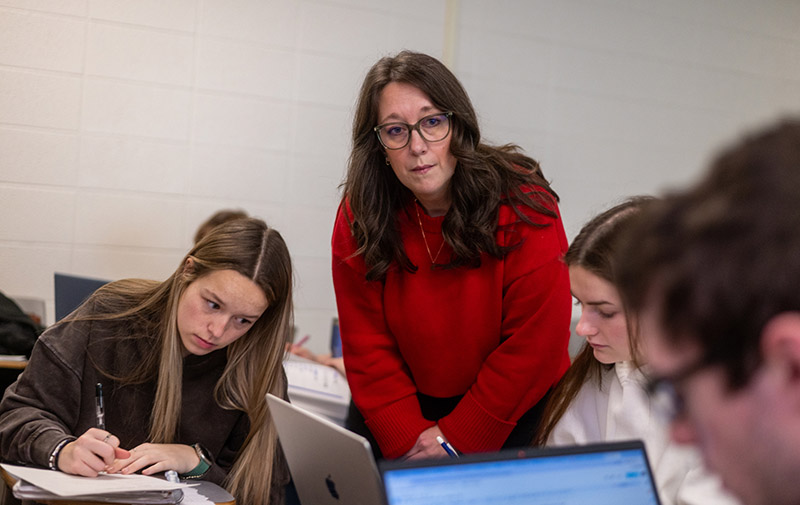
March 17, 2026. – When Ashley Moore, executive director of Citizens Against Sex Trafficking (C.A.S.T.), needed well-researched content for her group’s monthly newsletter, she reached out to University of Wisconsin-River Falls Criminology Professor Desiree Wiesen-Martin. The two worked together to come up with a plan that would not only provide the content Moore needed but would also give students in Wiesen-Martin's Victimology class some valuable real-world experience.
“We work to prevent human trafficking and exploitation in the Twin Cities and western Wisconsin through education, awareness and collaboration,” Moore said. “We want to bring accurate, relevant information to people so that they understand what's going on, because it's hard to fix a problem if you don't know that it exists.”
Moore has high standards for the content included in each “Preventative Power: Hope in Motion” newsletter. 100% of the information shared needs to be victim centered, trauma informed and evidence based. Wiesen-Martin saw an opportunity to put her students’ research skills to work in a beneficial way.
“I could have had them write a final paper that only I would see, but this was a chance to provide students with a meaningful project that not only helped them to build topic knowledge and transferable skills but will also have a positive impact on our local community,” Wiesen-Martin said.
Moore said people may be familiar with the concept of sex trafficking from news coverage, but many may not be aware of some of the other aspects of sexual exploitation, which involves any case where someone causes harm sexually for gain. That gain could be something tangible, like money, or something intangible, like power, control, popularity or acceptance. C.A.S.T. is working to educate people about such cases that are happening right in the region.
“Sexual exploitation could mean things like sextortion, which is blackmailing over sexualized content,” Moore said. “We’re hearing from schools that that is impacting as young as middle schoolers and late elementary.” In one case, students threatened to distribute photos unless a classmate did their homework.
Other activities that fall under the sexploitation umbrella include deep fakes, love bombing and sugaring, which involves engaging in a companion-type relationship in exchange for luxury-type items. The students researched around 20 topics for the newsletter.
“C.A.S.T. asked that the material focus on providing definitions, information that would help people contextualize the topic and steps that could be taken to prevent exploitation,” Wiesen-Martin said. “Community empowerment around an issue such as sexual exploitation is the goal, so our students worked to provide the reader with peer-reviewed, evidence-based information in an accessible and approachable format that would help community members be informed.”
Julia Siefert, a junior criminology major from Chisago Lakes, Minn., and Suzette Lain, a senior criminology and psychology double major from Oshkosh, worked in a group researching sexploitation and predatory behavior against children.
“We searched our library database to find the literature on how to define the terms,” said Siefert, who is preparing for a career in corrections. “Then we looked into research that has been done into fighting these issues.”
Lain, who hopes to work in substance abuse as a social worker, said they then worked to tailor the articles to specific audiences.
“We focused on different groups — schools, youth, parents and community,” Lain said. “We wrote the sections as if we were addressing them and included what we thought was most important for them to hear out of the article.”
Students produced rough drafts for peer review throughout the semester and presented their final work in a showcase for classmates and invited guests.
Wiesen-Martin said that while the students found the group work challenging and were nervous at first about seeing their work published, there were multiple benefits to working on the project. Students developed transferable skills, including the completion of group work, written and verbal communication, leadership and professionalism. They also produced articles they can use to demonstrate their professional development and provided a service to their community.
Lain and Siefert agreed that the experience stands out as both a challenge and a highlight of their educational journey at UWRF.
“In criminology, we’re working to go into careers that give back to people and help people,” Lain said. “It was exciting to know we could actually help the community by doing this.”
“I think I grew in what I thought I could accomplish,” Siefert added. “I would say it’s empowering that our undergrad work can be used in practical settings for the betterment of people.”
The articles produced in 2025 are now being distributed in the monthly newsletter. Moore and Wiesen-Martin were so pleased with the result for the students and C.A.S.T., that the spring 2026 Victimology class is now working on a new batch of articles.
“The quality and relevance of the research they did...they knocked it out of the park,” Moore said.
Anyone who is interested in following the articles can subscribe to the newsletter on the C.A.S.T. website.
Photo: UW-River Falls Criminology Professor Desiree Wiesen-Martin works with students in her Victimology class in February.