
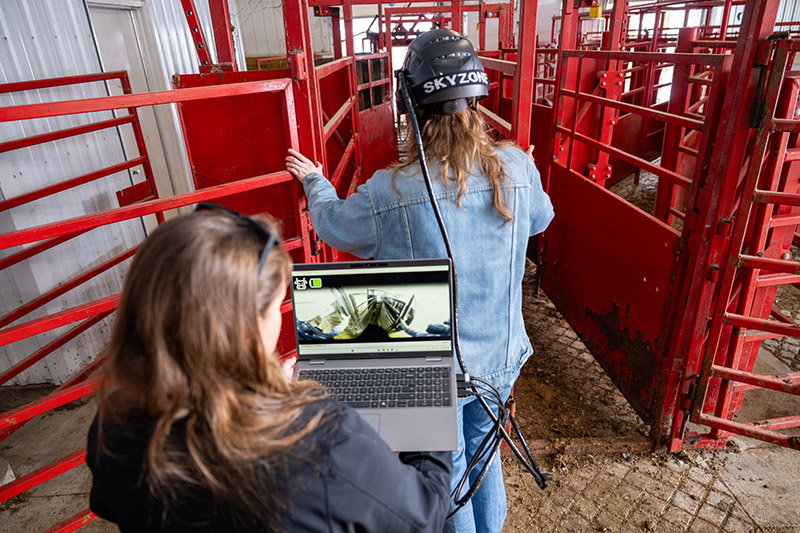
Through a cow’s eyes: Humane Handling Institute first in U.S. to use augmented reality goggles for animal handling training
Through a cow’s eyes: Humane Handling Institute first in U.S. to use augmented reality goggles for animal handling training
Feb. 10, 2026 – Have you ever wondered what the world looks like through the eyes of a cow? When your job is handling livestock, that information could be useful to know. That is the idea behind the augmented reality goggles being used to train animal handlers at the University of Wisconsin-River Falls Humane Handling Institute (HHI), the first organization in North America to put the technology to use.
Ashlynn Kirk, program manager of HHI and a UWRF alum, learned about the goggles, called the Animal Eye Simulator, during a technology presentation at an animal care and handling conference in 2024. She knew they would be a great addition to the institute’s training workshops and immediately began investigating the possibility of bringing them to HHI.
“The simulators allow the person that is wearing them to see the world like a cow would or a pig would or a horse would,” Kirk said. “We wanted to incorporate them into our training for animal handling to build empathy and help people who handle livestock get a better idea what cattle are seeing and experiencing as they move through a facility.”
Cows have wide peripheral vision that is sharpest when looking straight ahead. The colors they see are also different from human vision. They have dichromatic vision, meaning they only see in shades of yellow, brown and blue. Cows see light and shadows differently, too, and their eyes take longer to adjust to changes in light. Even for Kirk, who grew up handling cattle, the simulation was (literally) eye opening.
“When I put those goggles on for the first time, it completely changed my perspective,” Kirk said.
The simulators are produced by a German company, Computer Outlook Management, and had never been made available in North America. Kirk said it took about a year for the company to make the arrangements to export the simulators to the U.S. and for UWRF’s Department of Technology Services to help ensure HHI would be equipped with everything they would need to put the goggles and software to work, from compatible laptops to cords and chargers.
By fall 2025, HHI was ready to use the simulators in the animal handling workshops that it offers for slaughter plant personnel and UWRF students. Kirk says participants are already gaining a better understanding of not just how their animals behave, but why.
“You experience the world like the animal that you’re handling,” Kirk said. “Then you can take that into consideration in your facility design—how you’re moving them, where you’re standing, different lighting, different colors.”
This information can help handlers understand why cattle tend to stop or be fearful at certain points. Kirk said this can contribute to design improvements anywhere livestock are handled, including slaughter plants, sale barns and dairy farms.
The end goal of HHI and its workshops is to create low-stress environments for livestock, which is better for the animals and makes operations run more smoothly. The simulator technology has proven to be a valuable new tool.
“Our mission is to improve animal welfare, worker safety and trust in food animal agriculture through robust and meaningful education, outreach and research,” said Kurt Vogel, a professor of animal welfare and behavior at UWRF and the director of HHI. “The immediate response of nearly every person that has used the virtual reality system is simply ‘Wow!’ Ashlynn’s efforts to bring this technology to North America through her work in the Humane Handling Institute is nothing short of game changing for animal handlers in our part of the world. I’m so excited to see the effects this technology will have.”
For more information about HHI and its animal handling workshops, visit www.uwrf.edu/humane-handling-institute.
Photo: UW-River Falls student Natalie Furhman navigates a cattle chute wearing Animal Eye Simulator augmented reality goggles while UWRF Humane Handling Institute (HHI) Program Manager Ashlynn Kirk watches the simulator's display.