
Working across campuses for innovative business solutions
Working across campuses for innovative business solutions: UW-River Falls, UW-Eau Claire and UW-Stout students and faculty work together on innovative internship for Royal Credit Union
Three Universities of Wisconsin campuses partnered with Royal Credit Union to launch an innovative internship program using AI to support a local business. This story is one of four in a series showcasing the impact of this collaboration. Read more: Economic development story (Economic and Employer Engagement Office); Student story (UW-Stout); Collaboration story (UW-Eau Claire)
River Falls, Wis. — When Royal Credit Union, one of Wisconsin’s leading financial institutions with 330,000 members and 28 locations in Wisconsin and Minnesota, wanted to explore ways to use artificial intelligence to make informed business decisions based on data, the result was an innovative multi-campus internship program involving students and faculty from the University of Wisconsin-Eau Claire, UW-River Falls and UW-Stout.
Four students were ultimately hired to spend summer 2025 working with Royal’s Business Intelligence and Analytics Team as part of their new AI innovation Lab.
“We had identified that we wanted to be more innovative,” said Brandon Riechers, Royal CEO. “At Royal, we thought, ‘How can we leverage AI to improve people’s lives?’ The lab was a way that we could inject new ideas, test pilot certain things and build that momentum.”
Riechers said leveraging data allows Royal to proactively meet its members’ needs in a much more personalized and customized way. The first step in setting goals for the project was to create problem statements focusing on creating positive outcomes for members. Royal then turned to the three universities to flesh out the internship idea.
“We’ve been a great partner of the universities for a long time through our internships,” Riechers said. “We’ve always found through interns that our students that we work with have great ideas; they’re not hindered by any kind of preconceived concepts. They’ve got a natural curiosity that made it perfect for this kind of work in the innovation lab.”
Anthony Varghese, chair of the Computer, Information and Data Sciences Department at UWRF; Keith Wojciechowski, a UW-Stout professor of mathematics, statistics and computer science; and Rahul Gomes, an associate professor of computer science at UWEC, were tasked with helping to focus the project and finding student candidates who were up to the challenge of applying machine learning solutions to financial business problems.

“It was important to identify what qualifications were required for hiring these roles,” Wojciechowski said. “Then we could prepare the students and make sure they had the background necessary to solve the problems.”
The three faculty members met with the Royal team for a year in advance to understand what they wanted to achieve and help determine how an internship project could help meet those goals.
“We worked closely with the Royal team to ensure the internship projects aligned with both their workforce needs and with useful student-learning outcomes,” Gomes said.
“The end result was a nice, cutting-edge project that was also very down to earth and applicable to the kind of work these students will see in the real world,” Varghese said.
The faculty were critical in the formation of the program, said Chris Meyer, Royal’s vice president of business intelligence and efficiency.
“Bringing faculty from three different campuses together to talk about a business problem and collaborate together on how we could solve that with an internship program was a really neat experience,” Meyer said. “It was something I hadn’t been a part of before.”
The project was not only unique in terms of crossing campuses, it also involved more advanced work than a typical undergraduate internship. The students were effectively doing research and development work.
“To actually be doing machine learning and helping them test software was a much higher level than most undergraduates will have experience with,” Wojciechowski said. “These students became machine learning experts.”
During the internship, the faculty met periodically with the students and supervisors to help identify solutions to real-world challenges, such as how to deal with incomplete or imbalanced data. They also needed to ensure those solutions were efficient and explainable to a non-technical audience. Having three faculty members from different universities proved to bring a complementary mix of experience and expertise.
“We communicated regularly to ensure students were supported technically and professionally while also respecting Royal’s goals and timelines,” Gomes said. “Each faculty member contributed based on their strengths, creating a distributed mentoring model.”

Meyer said the internship program allowed Royal to try new, innovative ideas and provide value for its members in a low-cost, low-risk and high-reward way while their teams continued to focus on existing strategic projects and core work.
“The internship program allowed us to test out some platforms in using AI and make some decisions about what directions we go next without the sizeable investments that it would take otherwise in people and resources,” Meyer said.
All three faculty members involved in the project agreed that the multi-campus approach has potential for future projects with business partners.
“This could continue into the future and we could see this grow,” Wojciechowski said. “The outcome was really great.”
“I hope to see more structured, repeatable collaborations that span multiple UW campuses and focus on high-impact areas such as AI, data analytics, healthcare and sustainability,” Gomes said. "These opportunities will significantly benefit students, faculty and industry partners alike and have a positive impact toward economic development in Wisconsin.”
Internship opportunities like the Royal project are essential for students in preparing them to make the transition from the classroom to the workplace, Varghese explained.
“Being able to develop these skills in classes and then see what it is like in the real world with an internship is invaluable for our students,” he said. “They get the experience of working with a lot of different personalities and working through real-life situations that will serve them well in their careers.”
Riechers said the project was a success for Royal Credit Union and can serve as a model for future efforts.
“The real value to us as part of the innovation lab is the learning and insight that we are able to build momentum on for future problem statements,” Riechers said. “Absolutely, we would do it again.”
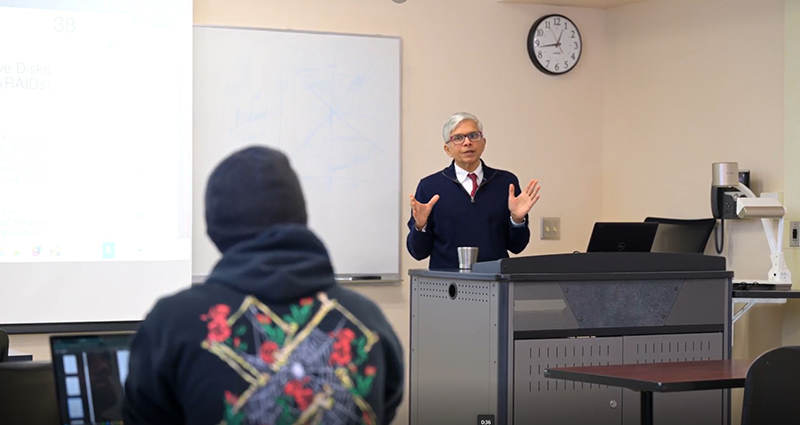
Top photo: Anthony Varghese, chair of the Computer, Information and Data Sciences Department at UW-River Falls, teaches a class. Varghese joined faculty from UW-Eau Claire and UW-Stout to advise four students involved in an innovative internship program at Royal Credit Union exploring the use of machine learning for business intelligence.
Inset photo #1: Headshot of Keith Wojciechowski, a UW-Stout professor of mathematics, statistics and computer science.
Inset photo #2: Headshot of Rahul Gomes, an associate professor of computer science at UWEC.