
UWRF MSCS prepares professionals for AI-driven careers
UW-River Falls master’s program in computer science prepares professionals for AI-driven careers
Jan. 13, 2026 - Business owner Derrick Edwards is doubling down on artificial intelligence.
“We are an example of an organization that is all in on AI in every respect,” Edwards said of AGS Data Systems, the company he founded in River Falls in 1999. “Every employee we have is provided with multiple AI tools, whether they are in sales and marketing, training and development, software or technology development. We are constantly, every meeting, every conversation, every day finding ways to leverage that technology to push our business model forward.”
Edwards’ company, which provides data collection management and analytic software platforms for workforce development and education, is also integrating AI into its applications so clients can leverage the technology to solve business problems.
In one example, AGS no longer writes professional training and technical materials for humans. Instead, the company developed its own process for writing materials to be fed directly to AI, which can then be shaped to deliver the information in the way the customer finds most appropriate. An organization can leverage that power to customize training materials for a non-native English speaker, for instance.
Edwards encountered some of the earliest expressions of these technologies as an undergraduate student in the 1980s, but as computing power has caught up with theory, computer science professionals find themselves in a fast-changing environment. Edwards says it is time to upskill or be left behind.
“There is a saying in the industry that AI is not going to take your job. Somebody who knows more about working with AI is going to take your job,” Edwards said. “Every job is going to be integrated with AI, just like they were with the internet or electricity.”
After 30 years in the field, Edwards found going back to class to earn his Master of Science degree in computer science at the University of Wisconsin-River Falls an engaging and valuable experience.
“For me it was focus and reinvigoration,” Edwards said. “Thinking through multiple aspects of the industry that I work in, the products we develop and especially interacting with other professionals broadened my horizons and stimulated my thinking, my ideation.”
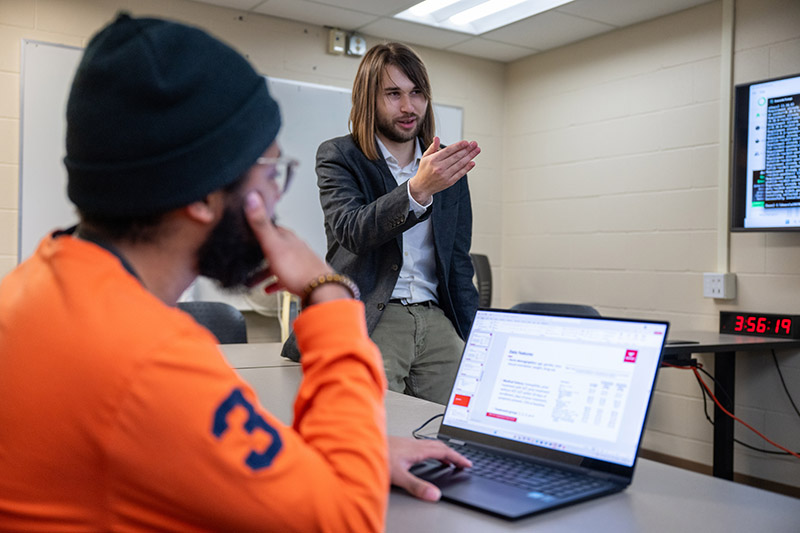
Ari Smith is an assistant professor who teaches courses in data science and machine learning in UWRF’s master’s program. He agrees that working professionals can put new skills in data science and machine learning to good use.
“People who have been working in an industry for a while know how to find a good question to ask, a good research question about information and predictions they might be interested in,” Smith said. “They understand the business context of how this would be helpful to the enterprise as a whole, and from the data scientist’s technical context, they can learn how to build a model that performs well at this task.”
Conversations about AI often revolve around generative AI using large language models, like ChatGPT or Microsoft Copilot, but the applications for data science and machine learning are much more diverse and specialized.
“Anywhere we can collect data about how things have happened or been done in the past, we can try to model for the future and see what sort of insights that might give us,” Smith said.
That could include generating a possible medical diagnosis based on a patient’s healthcare records, predicting a company’s future sales and revenue or modeling an efficient supply chain.
While many are concerned about AI eliminating some jobs, Anthony Varghese, chair of the Computer, Information and Data Sciences Department at UWRF, sees opportunity for those who are willing to learn.
“AI is changing the way work is being done in a lot of fields,” Varghese said. “People who have an AI background can contribute in many ways to industry and research. Companies are learning they need people with those skills.”
UWRF’s Master of Science in computer science is presented in a HyFlex learning model – a flexible hybrid arrangement that allows students to attend classes in person or online, either synchronously or asynchronously. It’s an approach that Varghese has found convenient for working professionals.
A formalized learning program in a flexible format is a good combination for those looking to upskill midcareer, said Edwards, and this is a good time to take that step.
“The career landscape is evolving,” Edwards said. “For those who have been working in computer science, this is an opportunity to expand and deepen their educational foundation while engaging with a community of practitioners.”
To learn more about the Master of Science in computer science, visit uwrf.edu/academics/master-science-computer-science-mscs or email mscs@uwrf.edu.
Photo: UW-River Falls Assistant Professor Ari Smith teaches a class in machine learning as part of the university's Master of Science in computer science program. The program is presented in a flexible hybrid format to accommodate working professionals looking to upskill in AI.