
UWRF hosts 800 high school students for Science Olympiad Border Battle
UW-River Falls hosts 800 high school students for Science Olympiad Border Battle
Jan. 26, 2026 – Braving frigid temperatures, around 800 students from 31 high schools across Wisconsin and Minnesota gathered at the University of Wisconsin-River Falls on Saturday to flex their mental muscles and compete in the Science Olympiad Border Battle.
While the extreme cold kept some of the most distant schools from attending, some of which travel from as far away as North Dakota, the event’s director, UWRF Chemistry Professor Jamie Schneider, was happy to see a busy, bustling event as students competed in 28 separate activities using nearly every building on campus.
“I love the energy, I love the enthusiasm,” Schneider said. “They’re competitive, but it’s about learning. Sometimes people think Science Olympiad is just all these kids that just want to do science, but for a lot of them, it’s about being part of a team.”
Around 150 volunteers helped keep the day running smoothly, including UWRF faculty, staff and students, community members and past competitors who enjoy coming back to help out.
Science Olympiad is an international nonprofit organization created in 1984 to improve science education by increasing student interest and recognizing outstanding scientific achievement. Science Olympiad tournaments lead to regional competitions and then state and national events. The UWRF Border Battle is an invitational that gives teams a chance to sharpen their skills before regional and state competitions. The community experts and UWRF faculty are known for putting together challenging tests, lab activities and engineering tasks to help students and coaches advance their learning, Schneider said.
Events can involve taking a written test, using devices students built in advance, or unannounced hands-on activities that require students to think on their feet. UWRF Physics Professor Lowell McCann designed and supervised one such event, “Experimental Design,” in which teams had to design and conduct an experiment on the spot based on the size of a loop that formed as a beaded chain fell out of a cup onto the floor. They were then graded on a written report that explained their methods and conclusions. All the work had to be completed within 50 minutes.
While this year’s challenge was physics-based, McCann said students are not told in advance what discipline they’ll be working on. They could just as easily have found themselves designing a biology or chemistry experiment.
“They have to be prepared for anything,” McCann said. “They need to apply the basic ideas of how you structure an experiment—what variable are you controlling, what variable you are varying and what you’re actually measuring.”
Other activities are laid out beforehand. For the “Machines” event, students built a two-lever system in advance and used it to measure the masses of three unknown items and calculate the ratios between them. They then took a written test. Oliver Boswell, a senior from Mounds View High School in Arden Hills, Minn., said he started working on his compound lever months before competitions began.
“I probably spent 50 hours working on it,” Boswell said, adding that he thought his device performed well. “It was very accurate. If my calculations were right, we’ll be pretty safe there. And the test went well.”
Students have the opportunity to win individual medals and team trophies at the awards ceremony at the end of the day. On Saturday, the varsity team from Mounds View High School took the top spot for large enrollment schools and for the overall tournament. The varsity team from Boyceville High School took the top spot for small enrollment schools.
One aspect of the Border Battle that Schneider is proud of is the diversity of the schools that participate.
“We have a lot of small, rural schools. We have urban and suburban schools too and I love that mix that comes together,” Schneider said. “For some of these kids, it’s the only opportunity they have to visit a college campus and see it as a place they could be some day.”
Andy Hamm, a math and science teacher at Boyceville High School, is in his 19th year of coaching Science Olympiad teams and has helped organize the Border Battle at UWRF since the very beginning. He is also a supervisor and rules committee chair at the national level. Boyceville is one of the smallest schools competing, with a high school of about 200 students, but it has around 80 Science Olympiad members between its high school and middle school teams. They have traveled as far as Los Angeles to compete.
Hamm said the students come from across the spectrum of the student body.
“We have three-sport varsity athletes, we have kids who are valedictorians and some who are just really interested in the hands-on aspect,” Hamm said. “I love it. I just see what it does for kids. It's such a huge way to get kids involved, get kids motivated, get kids excited. That's why I'm doing this.”
This year’s Science Olympiad Border Battle presented an opportunity to showcase UWRF’s brand-new Science and Technology Innovation Center (SciTech) just two days before the 136,000 square foot state-of-the-art facility opened for its first classes. SciTech is the new home to innovation and research ecosystems in biology, chemistry, physics and psychological sciences. It also houses the new University Business Collaboration Center (UBCC), designed to accelerate collaboration and partnerships with businesses in STEM fields and beyond. The community will be invited to tour SciTech during a grand opening celebration March 31 from 4 to 6 p.m.
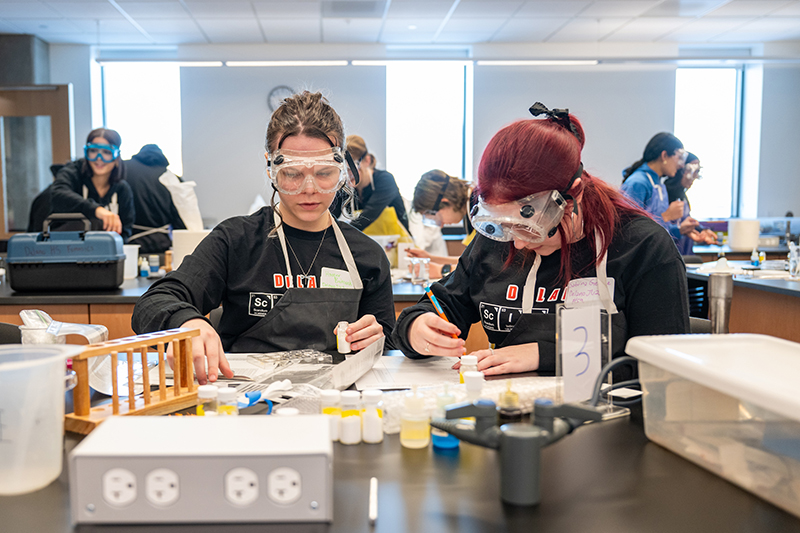
Photo: Students work together to solve a crime scenario as part of the “Forensics” event at the 2026 Science Olympiad Border Battle held Saturday at UW-River Falls. Around 800 high school students from across Wisconsin and Minnesota vied for individual medals and team trophies in the annual STEM competition. Students from Delano (pictured) were part of the team that won this year's pivotal Spirit Award Trophy for good sportsmanship, positive energy and enthusiasm for learning.