
AI in agriculture: UWRF partners with industry and alums
AI in agriculture: UW-River Falls partners with industry and alumni to train students in emerging technologies
Jan. 26, 2026 – If you picture working with artificial intelligence involving sitting in front of a computer at a desk in an office, Brandt Berghuis, a University of Wisconsin-River Falls assistant professor of crop science, can introduce you to a whole new world.
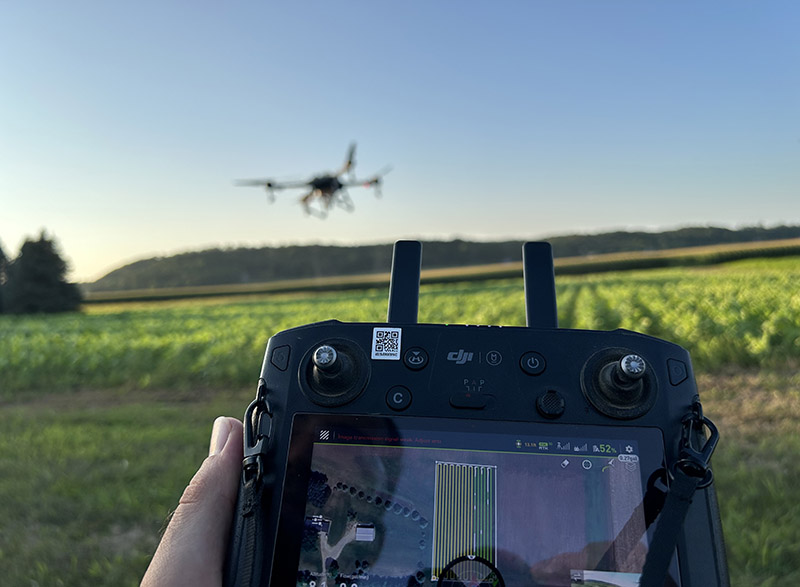
“AI is really transforming agriculture,” Berghuis said. “Things are changing really fast, especially in the field. We have drones now that fly over fields and use AI to do plant health ratings.”
That’s just one example. Another is self-driving, solar-powered robots that cruise through fields and use AI to identify weeds and spray them.
“It can optimize spray technologies by targeting just the weeds, reducing the need to spray,” Berghuis explained.
Other tools require no more equipment than a smart phone, such as an app that students can use to identify plants and weeds in the field. For students to be ready for today’s agriculture jobs, they need to learn about these technologies as they emerge.
“Artificial intelligence is changing the field, not just on computers,” Berghuis said. “For us to get out to the field and see some of these things in action—one, it's imperative, and two, it's just fun for our students.”
To keep up with these fast-changing technologies and make sure students have the chance to work with them, Berghuis said staying connected to industry has been crucial, and UWRF alumni often play a central role.
One of those essential partnerships has been with WinField United, a major provider of agricultural products, technology and other resources, which has an Innovation Center in River Falls. Many UWRF alumni work at the company and are now helping provide current students with access to new technologies.
“One year, they are your students, then a year or two later, they’re your colleagues and you’re working with them every day in the field, which is really fun,” Berghuis said. “They take our students out into the field and they light up with passion explaining what they have learned to the next generation of people in the ag industry.”
Lee Boles, a 2016 crop and soils science graduate, is one of those alums bringing the process full circle. Boles lined up an internship at WinField United through a UWRF Career Fair and is now a research manager in Seed Treatments & Emerging Technologies for the company.
“Working with students is incredibly rewarding,” Boles said. “Observing their growth from the start of their internships in summer to the end is particularly fulfilling. I also greatly appreciate students' enthusiasm when exploring new technologies. They consistently approach these advancements with a positive outlook.”
Carter Beaulieu, a 2024 UWRF agricultural business graduate, is an equipment specialist and seed lab technician at WinField United. He now works closely with UWRF interns and faculty.
“Moving to industry, and especially within the R&D group of Winfield United, I have really enjoyed being at the forefront of new and emerging technologies,” Beaulieu said. "I use many different versions of AI, one of which is to help collect and analyze plot data with a specialized imaging drone.”
Beaulieu said the technology helps his company deliver impactful, agronomic insights to retailers at the farm gate, and he enjoys playing a role in giving students learning experiences like the ones that helped prepare him for his career.
“I enjoy talking about the new technologies emerging within the ag industry,” Beaulieu said. “AI being used in technologies like sprayers, drones, tractors, etc., makes for exciting conversations with the students.”
Austyn Steinhaus, a senior crop science major from Cokato, Minn., and Mekelsy Sundby, a senior crop science major from Hudson, took advantage of the drone and AI technology to conduct field research into sunflower diseases at UWRF’s Mann Valley Laboratory Farm.
“Being able to use the drone in our project allowed us to learn firsthand what drones are capable of and how they can be used in research,” Steinhaus said. “Seeing what AI analysis could do with the data collected using the drone was very informative and showed us what AI is capable of when used for field data analysis.”
“Being able to have this kind of experience prior to graduation gives us a head start on our peers who have never seen this technology before,” Sundby added. “It shows us what is out there currently and can help guide us in the area of research that interests us the most.”
Berghuis said keeping up with the changes keeps his job as an educator interesting and he’s glad he gets to see past students sharing their expertise.
“Being able to actually work directly with industry to use some of the state-of-the-art equipment on our own trials at the Mann Valley Farm is immensely helpful for us,” Berghuis said. “And they're just great people to work with.”
Photo: Lee Boles, a research manager at WinField United, uses a drone to spray a field of sunflowers which will later be assessed by students for plant health, both in person and through drone imagery. Boles is one of many UWRF alumni who help introduce current students and faculty to emerging technologies in the field.