

Farm and Industry Short Course
If you have questions or want to learn more about the program, contact Mary Holle at 715-425-3704 or fisc@uwrf.edu.
Pursue Your Passion for Wisconsin's Iconic Dairy Industry
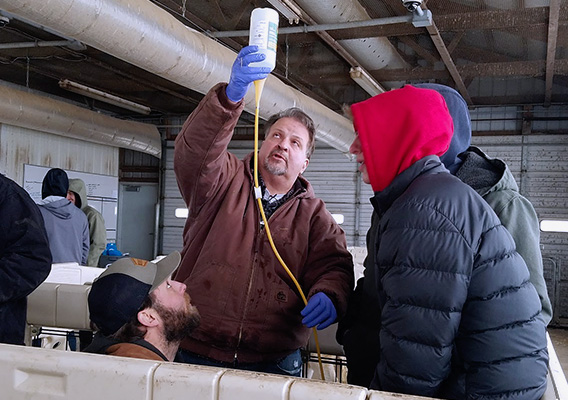
The Farm and Industry Short Course provides world-class, hands-on training targeting what you need to know to step into the dairy industry. Courses emphasize animal management, including animal health and welfare, nutrition, reproductive physiology and milk quality, and also include an introduction to basic business management and accounting. In the future, an advanced short course will dive deeper into herd management and the entirety of farm management. These are credit-bearing courses that can be used at UWRF or elsewhere if you decide to pursue a bachelor's degree in the future.
Program Overview
- The program will run from Oct. 21, 2026, to March 12, 2027.
- Classes taught by world-class UWRF faculty in collaboration with UW-Madison and UW-Platteville.
- Students live in UWRF residence halls.
- Access the same student privileges as four-year students.
- Earn college credits that can be used at UWRF or transferred.
- Create lifelong friendships, professional networks and mentor relationships.
FISC Courses
FISC Core Courses
Dairy Production and Nutrition
- Focus: Daily operations, nutrition, housing and cow comfort
- Why it’s critical: Forms the foundation of efficient milk production and overall herd performance
Dairy Reproduction and Animal Handling
- Focus: Estrous cycles, synchronization, AI and reproductive efficiency
- Why it’s critical: Reproduction drives herd turnover, genetics and long-term profitability
Herd Health Management
- Focus: Disease prevention, biosecurity, treatment protocols
- Why it’s critical: Healthy cows are essential for productivity, animal welfare and cost control
Crop and Forage Production (Agronomy)
- Focus: Soil health, fertility, cropping systems and forage quality
- Why it’s critical: Feed is the largest cost and strong agronomy directly impacts profitability
Agricultural Economics and Farm Business Management
- Focus: Financials, recordkeeping, decision-making and markets
- Why it’s critical: Farming is a business and profitability depends on financial understanding and management
Dairy Evaluation and Genetics
- Focus: Conformation, linear traits and breeding decisions
- Why it’s critical: Genetic decisions influence herd longevity, efficiency and future performance
Dairy Industries
- Focus: Farm tours, guest speakers and networking
- Why it’s critical: Connects classroom learning to real-world operations and career opportunities
Students also have the opportunity to participate in:
- Ag Forward Program
- Artificial Insemination Training
- DPW Mentorship program and PDPW Business Conference
- Special seminars with topics ranging from dairy reproduction to cover crops and agronomy
- Campus activities, including trips or events sponsored by the UWRF Dairy Club
Agronomy Specialty-Potential Expansion Courses
Advanced Soil Health and Nutrient Management
- Move beyond basics into manure management, variable rate tech and sustainability
Precision Agriculture and Data Management
- GPS, yield mapping, input optimization and modern decision tools
Forage Systems and Feed Efficiency
- Connecting crops directly to ration performance and milk production
Conservation and Environmental Stewardship
- Regulations, water quality, carbon and sustainability programs
Crop Marketing and Risk Management
- Grain markets, contracting and input cost strategies
Beef Specialty-Potential Expansion Courses
Beef Production Systems
- Cow-calf, backgrounding, finishing and understanding the full pipeline
Beef Nutrition and Feedlot Management
- Rations, gain efficiency and cost of gain
Genetics and Crossbreeding Strategies
- Terminal vs maternal traits and heterosis
Meat Science and Carcass Evaluation
- Quality grades, yield and value-based marketing
Direct Marketing and Niche Beef Markets
- Freezer beef, branding and consumer trends
Beef Health and Handling
- Processing, vaccination protocols and low-stress handling
Second-Year FISC-Business Specialty Potential Expansion
Advanced Farm Financial Management
- Focus: Balance sheets, income statements, cash flow and benchmarking
- Why it’s critical: Enables informed, data-driven decisions that improve profitability and long-term stability
Agricultural Lending and Capital Planning
- Focus: Loan structures, credit analysis, lender relationships and capital investment
- Why it’s critical: Prepares students to manage debt, expansion and financial risk
Risk Management and Insurance
- Focus: Insurance tools, liability, price risk and crop/livestock coverage
- Why it’s critical: Protects operations from financial shocks and uncertainty
Farm Transition and Succession Planning
- Focus: Estate planning, generational transfer and business structures
- Why it’s critical: Ensures continuity and long-term viability of family operations
Human Resource Management in Agriculture
- Focus: Hiring, labor law, training, retention and communication
- Why it’s critical: Effective labor management improves efficiency and workplace culture
Agricultural Law and Regulation
- Focus: Contracts, environmental compliance and labor regulations
- Why it’s critical: Helps producers operate within legal frameworks and avoid risk
Marketing and Price Risk Management
- Focus: Milk pricing, futures markets, contracts and input purchasing strategies
- Why it’s critical: Managing volatility is key to protecting margins
Technology and Data in Farm Management
- Focus: Software systems, data analysis and precision ag economics
- Why it’s critical: Data-driven decisions improve efficiency and competitiveness
Enterprise Analysis and Strategic Planning
- Focus: Enterprise budgets, cost of production and expansion planning
- Why it’s critical: Guides resource allocation and long-term business growth
Communication and Professional Development
- Focus: Leadership, negotiation and working with advisors
- Why it’s critical: Strong communication drives better decisions and relationships
Agricultural Tax Planning and Strategy
- Focus: Farm tax structures, depreciation, income averaging and capital gains
- Why it’s critical: Tax management directly impacts profitability and long-term financial planning
Agricultural Policy, Government Programs and Advocacy
- Focus: Farm bill programs, FSA/NRCS involvement, subsidies, compliance and policy process
- Why it’s critical: Understanding government programs and policy helps producers access resources, remain compliant and advocate for their operation and industry
Approximate Expenses
| Approximate expenses for Farm and Industry Short Course (based on 2023-2024 values, costs likely to vary in 2024-2025) | |
|---|---|
Tuition and Fees (Wisconsin resident)* Required cost. Potential to earn up to eight academic credits/semester. | $3,160 |
Housing: Double Room Residing in a campus residence hall is required unless an exception is approved by UWRF Residence Life. | $1,300 |
Meal Plan Required cost when staying in residence hall. | $500 |
Parking Recommended. | $275 |
| Total charges per semester | $5,235 |
| Total charges for year (16 weeks) | $10,470 |
* Tuition/fees will vary depending on residency status. Please visit Student Billing for more information.

Application Information
Ready to apply? This step-by-step video walks you through the process.

Frequently Asked Questions
How do I apply?
Click "Apply Now" button at the top of this page. You can also view the short video posted to help explain the process.
What are the application requirements?
A high school diploma or equivalent. Students do not have to be from a farm.
- If you're enrolled in high school when you apply, then we can work with your unofficial transcript.
- If you've already graduated high school when you apply, we'll need your final official transcript.
Follow your high school's procedure for sending your official final high school transcript. Transcripts must indicate your graduation day, month and year, include all course grades and your final GPA. Electronic transcripts are preferred and must be sent through an official transcript service to admissions@uwrf.edu. Mailed transcripts can be sent to UWRF Admissions, 410 S. 3rd St., River Falls, WI 54022. To be considered official, the transcript must come directly from your school.
What is the focus for FISC?
The first year is very dairy farm-focused. There will be some education in agronomy, business and other areas but dairy is the key focus. Students who are interested in dairy ownership, dairy herd management or are working with a herd will be best served by this program.
FISC has a dairy focus, what if I’m more interested in other areas such as agronomy?
As we launch the FISC program at UW-River Falls, we are focusing on dairy. We may expand the offerings in the future.