November 2008
Applications for ITC Spring 2010 are now being accepted. A maximum of 35 students will be selected to participate in the program in 2010. See
the application material and instructions for applying below.
THE ITC IS LIKE NO OTHER ACADEMIC
TRAVEL PROGRAM ANYWHERE
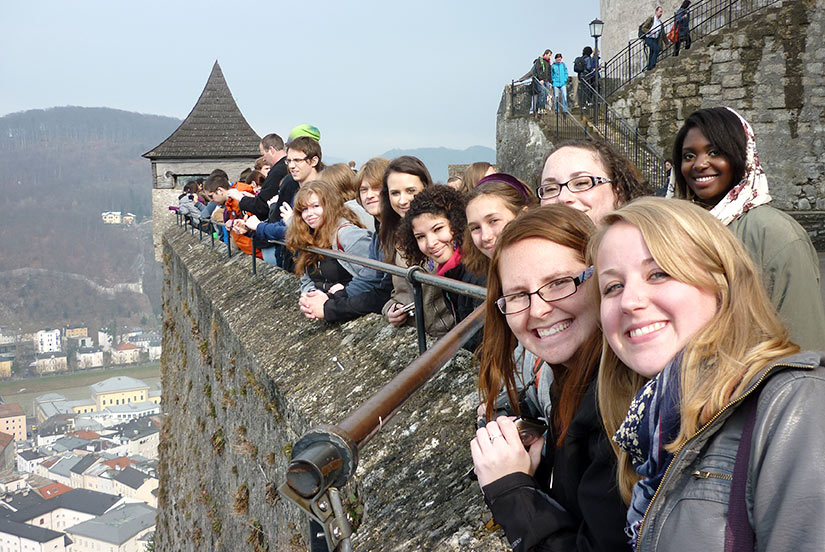
The International Traveling Classroom (ITC) is a program that allows you to travel and study in several different countries in Europe over the course of a semester.
As a participant you live and study in places such as Paris, London, Lyon, the Pyrenees, Berlin, Verona, San Sebastian, and more. You enroll in UW-RF courses, earning credits toward your degree. Living in these European locations offers fascinating learning experiences that aren't available on the home campus, such as visiting key historical sites,immersing yourself in local cultures.
In addition to group travel, you will have plenty of time to see the sights and travel independently. You will explore our "home" cities, make weekend trips to other places within the countries where we'll be based, and have two full weeks at the end of the semester to travel wherever you choose within western Europe.
Prior to departure we hold several orientation meetings to prepare you for the semester. These meetings cover specifics related to travel, accommodations, communication, budgeting, safety, etc. ITC staff will be available to help answer your questions both before we leave and while we are in Europe.
The benefits of studying abroad are unambiguously clear. You learn more about yourself and other cultures, develop self-reliance and other skills that can help you both in your personal and professional lives. Students who have studied abroad share comments about their experiences. The ITC is a very affordable semester abroad program. Financial aid and grants are available and traveling as a student allows you to tap into discounts that are unavailable to non-student travelers.
Students from all disciplines are encouraged to participate in the ITC. Most courses meet either general education, liberal arts, or other requirements (see separate listing). In some situations it might be possible to arrange independent readings, or internships.
Here are the most frequently asked questions:
1. When will we leave and where will we go as a group?
We will leave near the end of January
and return in May, being based in several locations such as London,
the Pyrenees, Paris, Lyon, Prague and Berlin. A
2010 itinerary can be accessed HERE.
Note that you might be able to extend your stay in Europe if you
wish.
2. Will I have time to travel?
Definitely! We expect you to take some weekend trips, and to travel at the end of the semester independently. One of the advantages of the ITC is that you'll be with a group for much of the semester and ITC staff will be available to answer your questions and help you make plans. We'll have thorough orientations that cover the main questions about traveling abroad. You might choose to spend some time traveling alone (we'll cover safety tips and other issues related to that), or you might spend time traveling with others in our group. If you want to travel to Venice, for instance, chances are there will be others in the group that want to do the same!
3. How will I travel within Europe?
Europe has wonderful transportation systems, including trains, buses, trams, and more. We'll talk extensively about different modes of transportation, costs, during orientation.
4. Where will we stay?
We reserve spots in youth hostels and hotels. These are relatively inexpensive options for travelers that allow you to meet people from all over the world. They often have kitchens, internet access, tv rooms, and other amenities. The rooms in hostels are somewhat like residence halls or dormitories with several beds per room.
5. Where will we hold classes and what classes are available?
We hold classes in the facilities where
we stay, and learning in Europe presents wonderful opportunities
that simply aren't available on our home campus. We supplement classroom
experience with group activities, such as viewing London Theatre
in London as part of a theatre course, or visiting the National
Assembly in Paris as part of an examination of French politics,
and more. The classes are designed to meet general education, liberal
arts and other requirements. Click HERE
for a full listing. If you have any questions, please contact the
ITC Coordinator
6. Why should I study in Europe now?
- There's never going to be a better time
- It is a life-enhancing experience
- You'll meet fascinating people, and experience foreign cultures first-hand
- You'll have a great academic experience
- Your experience will make you more attractive to potential employers
- It's affordable: financial aid is available, you can take advantage of student rates
7. How much will it cost, and is financial aid available?
We anticipate that the total cost
will be about $6,000 - $6,500 more than what you'll spend for tuition,
fees, and basic living expense for a semester on the home campus.
The cost is not fixed because you'll be able to control some of
your budget (e.g., how much you spend on food, what type of travel
arrangements you make, and so on) The figure includes airplane transportation,
typical local travel expenses, insurance, and other basic items.
Financial aid is often available to cover the additional costs associated
with academic experiences abroad.
8. When do I need to decide and how do I apply?
We plan to take 30-35 students, and
slots are being reserved on a first-come, first-served basis. You
need to complete an APPLICATON FORM,
submit a non-refundable deposit of $150, and obtain a letter of
RECOMMENDATION from a faculty
member. Be sure to consult the ITC CHECKLIST,
too. Act now. Don't miss out! It's the chance of a lifetime!
9. What forms and additional information are available?
Don't hesitate to contact the ITC
Coordinator or other staff if you have questions:
|