1910-19: The Beginning
In 1911 the Wisc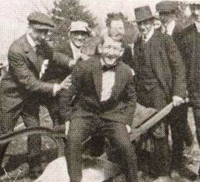 onsin legislature passed a law establishing that agriculture be taught in the high schools, thus creating a need for teachers of agriculture. The River Falls Normal School already offered a course in agriculture taught by Winthrop Welles, who saw the opportunity for the school to establish a specialty in agriculture. President Crabtree was interested in building up the school and saw this as an opportunity to attract another group of students, and students from across the state. Through local Regent, Philip W. Ramer, President Crabtree successfully appealed to the Board of Regents for authority to establish a special curriculum in agriculture.
When scho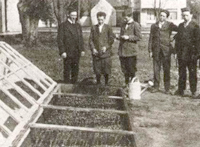 ol opened on September 2, 1912, there were 40 students in the program. That very first year, students and staff organized a livestock show. In the early years a large tent was erected for the show. As the show grew in popularity, faculty members and local farmers co-signed on a bank loan to build a 300 foot stall shed. The show was an annual event organized by upper-classmen until 1923 when county fairs took over this role.
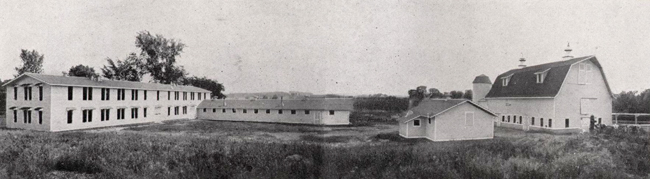
By 1914 the school started acquiring land for a farm. The first 14 acres were just west of South Hall. Where Stratton Hall now stands there was a small house, a stone cellar and two small sheds. For the first few years, the cellar served as housing for a few cows and a team of horses. Over the next few years additional acreage was purchased so that by the end of the decade the farm was just over 100 acres.
Bec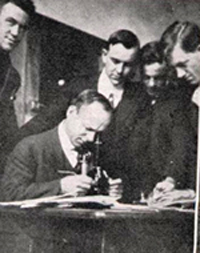 ause of the passage of the federal Smith-Hughes Act in 1917 which subsidized high schools offering agriculture instruction, the program at River Falls boomed. The River Falls Normal School was quickly approved by the State Vocational Board as an institution to train agricultural teachers. Approval was also needed from the Federal Board to obtain funds and have River Falls graduates accepted on an equal basis with those from the land-grant campus in Madison. The Federal Board wanted River Falls to be better equipped before being approved – they wanted a hog house, a barn, a milk house, a tractor and more animals among other items. It wasn't until 1919 that the Wisconsin legislature appropriated funds and construction started immediately on a "modern" 25 stanchion dairy barn. The barn was built for $5000 on the site where the Agricultural Science building now stands.
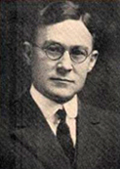
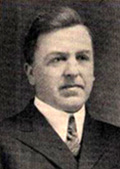
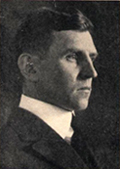
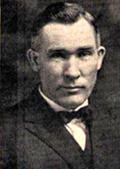
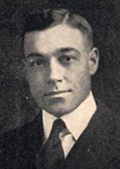
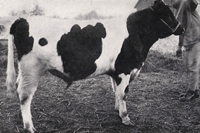 “There was 60 acres of sandy land, very poor land, six to eight scrubby cows, and that was about it. So we went to work right away and bought a bunch of cattle on notes. We gave some of our own notes for the cattle. We got some good Holsteins and we were successful in getting a good sire in the first one.”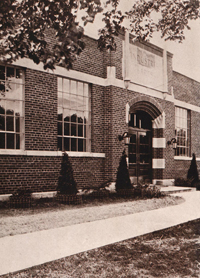
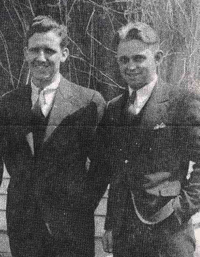 However enrollment varied quite a bit during this period and the depression made placement of graduates very difficult. In 1934, 20 seniors graduated from the program and there were no openings for teachers. The graduates found jobs as cow testers and took other menial work. Only seven freshmen enrolled in fall 1934 and a few of these dropped out after a few weeks. Anticipating criticism that the department faculty might not be fully occupied, President Ames requested that they offer extension courses in neighboring communities. Overall though enrollment increased through the 1930s, allowing the department to add two new faculty by the end of the decade – Thorvald Thoreson and Melvin Wall.
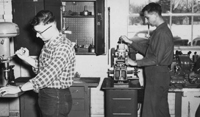 More improvements were made in the agriculture facilities during this decade than in the previous 40 years combined. Two laboratories in North Hall, one for crops and one for dairy, plus an office and a small shops building constituted the academic facilities for the program until 1955. In 1955 the agronomy building was completed providing three laboratories, a classroom, and four offices. With the rapid increase in enrollment though, it quickly became inadequate and staff were forced to share offices.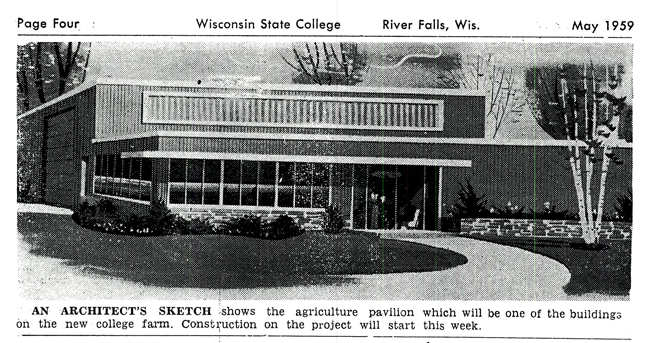
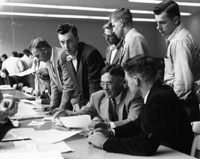 away. Campbell retired in 1953 after 26 years on staff. By the end of the decade the three remaining founding fathers announced their retirements – May in 1957, Prucha in 1958 and finally Johnson in 1960. The impact of these founders was evident at John May’s retirement when former students and friends from coast to coast - a truly remarkable 840 graduates - came back to honor him. They presented him with many gifts and enough cash to last him for years. The Department of Agriculture was considered by most to be a monument to May and his dedication and skill in guiding it through many seemingly hopeless times. Similar sentiments were expressed about Arthur Johnson, who saw the farms through many rough periods, often signing personal notes on loans to help out when things were at their worst. The names of May and Johnson were said to be synonymous with River Falls agriculture.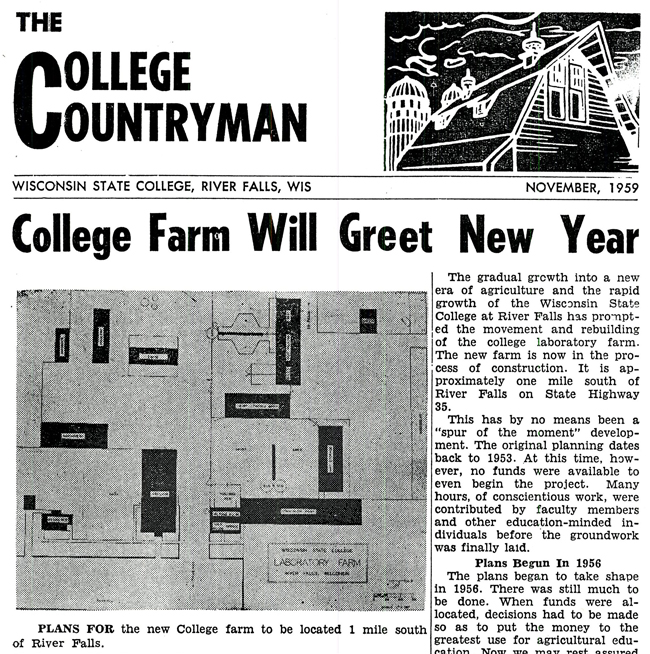
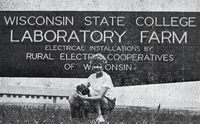 The decade started on a high note: In October 1960 the new $240,000 College Laboratory and Demonstration Farm was dedicated. Although it was noted that many visitors failed to register in the guest book, 777 guests were recorded for the event. The hub of the new facility was the Pavilion, a concrete block building to be used for teaching as well as farm shows, stock sales and other events. Within 4-5 years though, there was a drastic need for additional land as campus expansion
 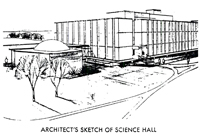 enveloped land that had been part of the farm. In May 1964 the purchase of additional farm land was approved and the 293 acre Herbert Turner farm, two miles northwest of the city of River Falls, was acquired for $82,500. This farm was to provide pasture for the beef cattle and sheep as well as additional acreage for the production of feed crops. At the same time plans for construction of the new $2 million Agriculture-Science Building were nearing completion. It was to house facilities for the agricultural sciences, biology, mathematics and the earth science programs. The building was completed on September 1, 1966.
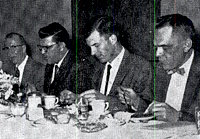 The FFA and Agrifallian Society combined efforts to hold the first Agriculture Division Banquet in March 1960. Of note was the title to the article in the College Countryman newsletter regarding this event - Women Invade the Banquet - for the first time wives and girlfriends of the members and faculty attended.
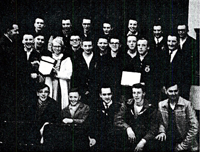 including 646 boys and 1 girl – marking the first time a girl participated in the contest. Colby, the team with the lone female participant, took first place that year.
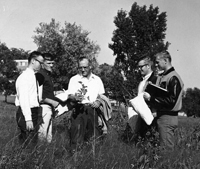 The long and rich history of college involvement in international activities began in the early 1960s. In 1963 Dick Delorit led a People to People agricultural tour to the Soviet Union, one of many organized by the U.S. State Department. Recent graduate Dick Jensen recruited Marv Thompson to visit Nigeria in 1965, as part of a curriculum and teacher development project. Jensen was later recruited for a supervisory role in a USAID project in Nigeria and was stationed in Ibadan. In 1967 Mel Wall traveled to Vietnam as part of a U.S. foreign assistance delegation of eight faculty and administrators studying the higher education system in Vietnam. Sadly all eight members were killed in a plane crash during turbulent weather in a mountainous region north of Da Nang. The Melvin Wall Amphitheater on campus, the only one of its kind on any Wisconsin campus, was designed by Wall and built by hundreds of students, faculty and friends of the university. The official memorial to Wall is the fountain located to the north of the Ag Science Building, which was donated by his wife.
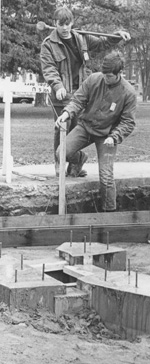 The start of the decade found the college and campus in the midst of planning and construction of the Wall Memorial Fountain and the Wall Amphitheater. Thorvald Thoreson, professor of Agricultural Engineering Technology, took on the role of the Chair of the Campus Planning Committee overseeing these two initiatives honoring his colleague and classmate, Mel Wall. Wall had been the long-time Chair of this committee and laid the groundwork for the amphitheater, modeling it after one he had seen on a visit to northern Italy.
 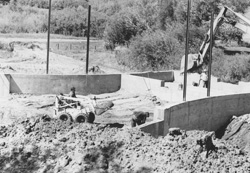 Sadly, the first Wall Memorial Fountain, donated by Wall's widow, was destroyed by vandals. The agricultural fraternities, DTS and AGR, took the lead, and with the help of other students, campus Facilities staff, and the Art and Ag Engineering departments, a new fountain was completed by commencement in spring 1970. The Wall Amphitheater was dedicated in 1972 with a performance by the Minnesota orchestra.
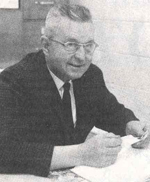 In the fall of 1972, Thoreson took a two-year leave of absence to accept a temporary position with USAID. He and his wife went to Nigeria to help establish an Ag Engineering program at the University of Ife in Ife-Ife. In 1973, while in Nigeria, Thoreson suffered a serious head injury in a road accident. He was quickly evacuated, first to Germany and then to New York for restorative brain surgery. By winter 1974 Thoreson was back on campus, but he was unable to resume his teaching career. He maintained an office on campus for many years, and with a cheerful attitude he did what he could to help out.
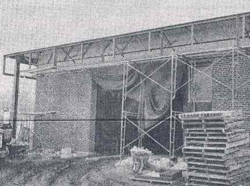 The decade was marked by growth in many ways and this includes facilities. In 1971 a 3600 ft2 addition to the Ag Engineering Annex was completed. A 3700 ft2 greenhouse was opened in 1973. Late in 1978, funds were secured from the UW-System to build the Food Science Addition, with construction anticipated to begin in two years. By the end of the decade, 1979, construction began on the third and final addition to the Ag Engineering Annex. The 11,890 ft2 of space included laboratories, offices and storage space to replace the outdated facilities in the 50-year-old Industrial Arts building. In 1979 the governor also approved a School of Veterinary Medicine for the University of Wisconsin. The main school was to be built in Madison and a satellite facility located at River Falls.
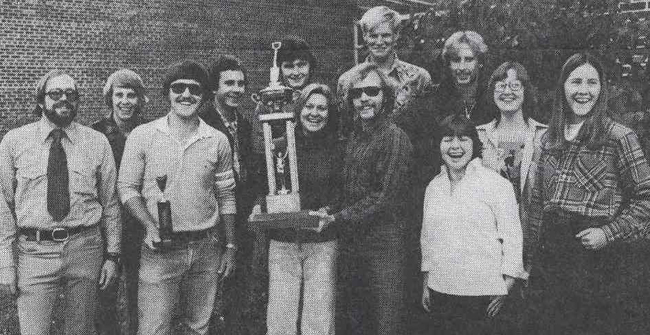 Over the 10 year period enrollment doubled and new majors were added in agricultural marketing, food science, scientific land management and general agriculture. The student body changed markedly over the 10-year period. In 1970, women made up less than 5% of the student body in the College; by 1975 they represented 17% of the enrollment. Just four years later in 1979, over 30% of the students enrolled in an agriculture program were women.
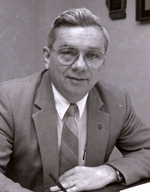 The decade started on a sad note with the untimely death of long-time Dean of the College of Agriculture, Jim Dollahon. Dollahon was scheduled for a one year sabbatical with the USDA in Washington DC. On the day planned for his send-off party, May 25, 1980, he died of a heart attack while taking a flight test for his private pilot’s license. Roger Swanson was named acting dean of the college while a search for a replacement was initiated. In 1982 a familiar face was named the new Dean, Gary Rohde. Rohde had been assistant dean of the college in 1976 when he took a leave of absence to serve as the Secretary of Agriculture for Wisconsin.
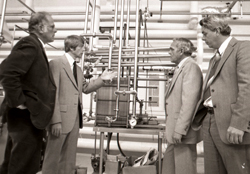 1980 also saw the beginning of construction on the Food Science Addition that would extend westward from the main building. Prior to this, the Food Science program was primarily housed in May Hall, occupying spaces that had been used by the campus food service operations prior to the opening of Rodli Hall. The area was off the beaten track, and had to be accessed through the basement lounge of May Hall, a men’s residence hall. The new facility was dedicated in December 1982 and came on-line for classes in Fall 1983. One year later in fall 1984, the dairy plant officially began commercial production and offered squeaky fresh c
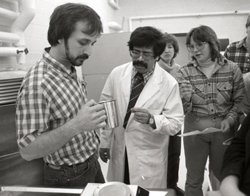 heese curds with the promise of pressed cheese and ice cream to come.
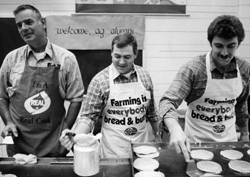 After several years of planning and with guidance from a steering committee of alumni, on September 24, 1983 the UWRF Agricultural Alumni Association was formally organized. A group of 60 alumni met to approve the constitution and by-laws, and elect a board and officers. Bill Sazama ’65 was elected president. The first official alumni gathering was the Homecoming Breakfast on October 8. In May 1984 the association sponsored the first Senior Breakfast (now a Senior Dinner) welcoming the soon-to-be graduates into the alumni ranks.
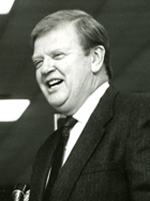 In 1984 Orion Samuelson, host of the nationally syndicated television show, U.S Farm Report, came to campus. He filmed segments for future broadcasts, gave a public address in the afternoon and was the keynote speaker for the Ag banquet in the evening. Samuelson returned to campus in 1989 to do an update, highlighting changes in colleges of agriculture. He interviewed Phil George, P.C. Vasavada and Terry Ferriss during this visit.